Playing Keno in New Zealand: Rules and Payouts
 Available in US
Keno entries combine a number selection and stake, with results assessed against scheduled draws and payouts set out in prize tables.
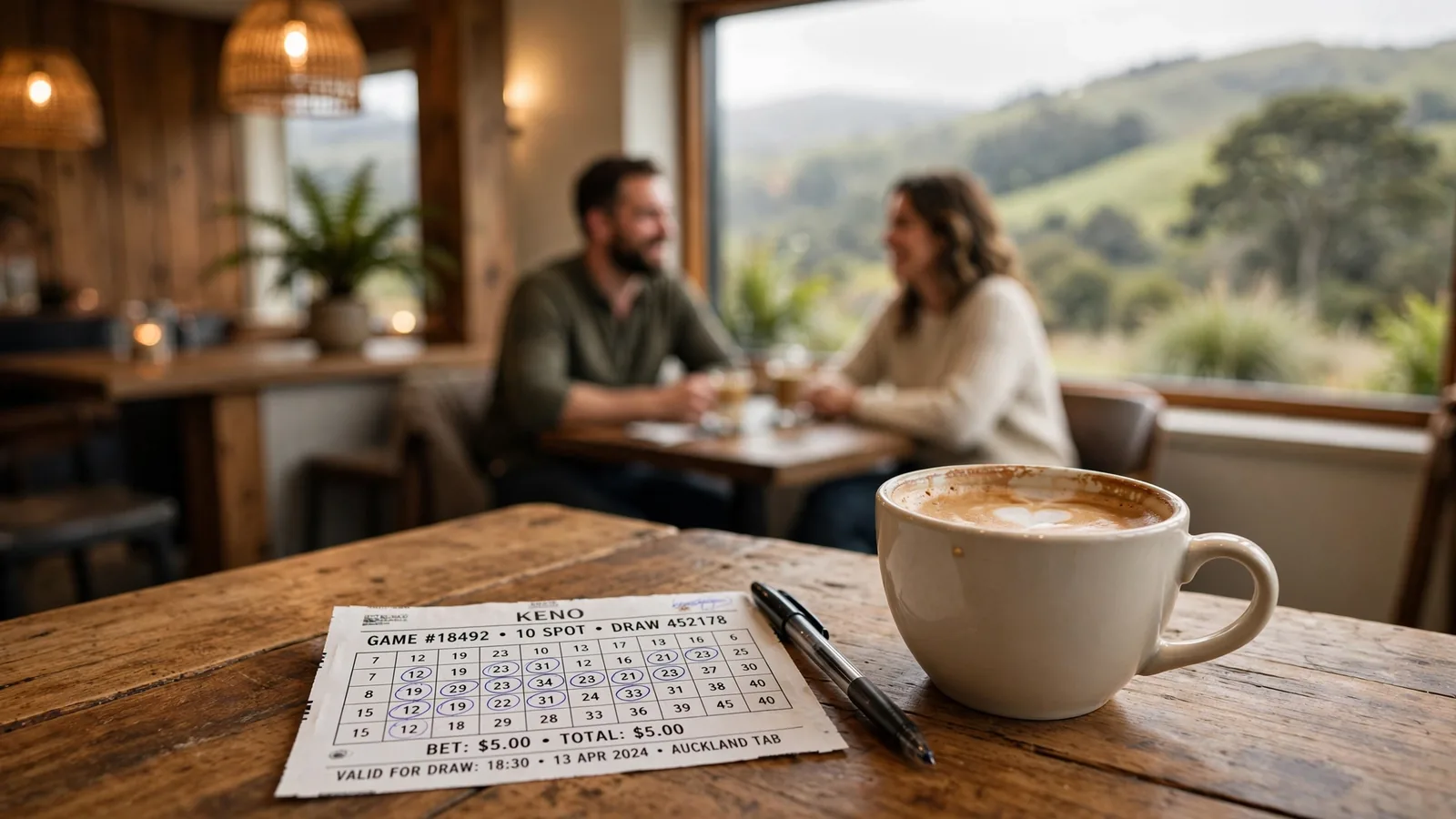
Table of Contents
- How Keno Draws Work: Numbers, Selections and Entry
- How Many Numbers Do You Need to Match to Win?
- Keno Rules, Entry Deadlines and Unclaimed Prizes
- Keno in New Zealand: How the Licensing Transition Affects the Market
- Daily Keno and Where You Can Enter
- How to Read a Keno Prize Table
- Keno Payout Charts: What the Numbers Depend On
- Keno Winners in New Zealand: What a Draw Can and Cannot Tell You
- Does Keno Work Differently in New Zealand?
- Is There a Maximum Keno Win in New Zealand?
How Keno Draws Work: Numbers, Selections and Entry
Keno starts with a fixed pool of 80 numbers. For each draw, 20 are drawn from that pool. To enter, you choose numbers from the pool and decide how much to stake on your selection. The draw then supplies the results against which your entry is assessed.
The sequence is straightforward: choose the numbers, choose the stake, submit the entry for a scheduled draw, and make sure it is submitted before that draw closes. The selection and stake are separate parts of the entry. Changing the number of selections changes what you are asking the game to assess; changing the stake changes the amount attached to that selection.
Choosing numbers
The number of selections you can make is described inconsistently. One account of online Keno gives a range of four to twenty numbers, while another description of Keno gives a range of one to ten. Those ranges cannot be combined into one rule that applies to every Keno entry. Check the options shown for the particular game and entry method you are using rather than assuming that one range covers all versions.
Choosing where to play keno in New Zealand means checking what is actually known about each operator before you decide. Use these details as a starting point and confirm the terms that matter to you.
License: Malta Gaming Authority, licence no. MGA/B2C/370/2017 Play Grand is listed with a Malta Gaming Authority licence, no. MGA/B2C/370/2017.
Payout speed: 1-3 business days Lamabet lists a payout speed of 1–3 business days.
License: Malta Gaming Authority, licence no. MGA/B2C/394/2017 N1 Casino is listed with a Malta Gaming Authority licence, no. MGA/B2C/394/2017.
Payout speed: 1-3 business days Wintino lists a payout speed of 1–3 business days.
License: Curaçao Gaming Authority, licence no. OGL/2024/165/0185 BitStarz is listed with a Curaçao Gaming Authority licence, no. OGL/2024/165/0185.
License: Tobique Gaming Commission, licence no. 0000064 Neospin is listed with a Tobique Gaming Commission licence, no. 0000064.
License: 07017519840 · Payout speed: 1-3 business days Zotabet lists the identifier 07017519840 and a payout speed of 1–3 business days.
License: Tobique Gaming Commission, licence no. 0000091 7Bit Casino is listed with a Tobique Gaming Commission licence, no. 0000091.
License: Tobique Gaming Commission, licence no. 0000002 Ricky Casino is listed with a Tobique Gaming Commission licence, no. 0000002.
Your selected numbers form the entry, sometimes referred to as a line. In practical terms, the line is the set of numbers you have chosen for the draw. You are selecting from the game’s pool; the draw itself is separate and produces its own set of 20 numbers. The selection is not a prediction that changes the draw or influences which numbers are drawn.
When choosing, keep the entry’s selection count in view. If you mark more numbers, your line contains a larger selection; if you mark fewer, it contains a smaller one. The number of selections is therefore part of the entry’s structure, not simply a display preference. The options available may depend on which Keno format you are entering, as reflected in the disagreement about selection ranges.
Setting the stake
Keno lines start at $1. For standard Keno, the available cost options per selection are $1, $2, $3, $4, $5, $10, $20, $50 and $100. These are stake choices, not different draw sizes: the draw still consists of 20 numbers from the pool of 80.
Read the cost as applying per selection, not as a single amount that automatically covers every possible line. This distinction matters when an entry includes more than one selection. Before submitting, confirm both the numbers marked and the cost displayed for the entry. A correct number selection with an unintended stake is still an entry at the displayed cost.


The interface may present the number choice and cost choice as separate controls. Treat them as separate checks. First confirm the numbers included in the line; then confirm the cost attached to each selection and the total shown for the entry. Do not infer a total from the number of marks alone, because the stake option also affects the amount charged.
Submitting for a draw
An entry must be submitted for a scheduled draw. It closes at the scheduled draw time, so the relevant cutoff is the time assigned to that draw. An entry made after that point cannot be treated as an entry for the draw that has already closed. Allow time to check the selected numbers and stake before confirming, rather than relying on the last moment.
The basic answer to how to play Keno in New Zealand is therefore procedural: choose a permitted number of numbers, select a cost option, and submit the completed entry before the scheduled draw time. The draw then selects its 20 numbers from the pool of 80. Keep the selection and stake details visible while you confirm the entry; each defines a different part of what you have submitted.
How Many Numbers Do You Need to Match to Win?
A Keno result is based on the overlap between your selection and the numbers drawn. In Keno NZ, you select from a pool of 80 numbers, and 20 are drawn. A hit is one of your selections appearing among those drawn numbers. The total number of hits is therefore the count shared by your selection and the draw.
Attention: There is no single match count that guarantees a win; the required number of hits depends on your specific selection size and the game rules.
There is no single match count that applies to every selection as a universal winning threshold. You can choose between one and ten numbers, and the outcome depends on both how many you select and how many of those are drawn. A result with several hits means something different for a small selection than it does for a larger one. To know whether a particular result qualifies for a prize, you need the rules or prize information for that specific selection. The mechanics alone do not establish a universal number of hits that guarantees a win.
Why selection size changes the chance of a match
When you select more numbers, you have more numbers that could appear in the draw. That creates more opportunities for a hit, but it also changes the standard against which the result is assessed. The draw still contains 20 numbers from the same pool; choosing a larger set does not alter what is drawn. It changes only the set you compare with the result.
For an individual selected number, the chance of appearing depends on the draw’s size relative to the pool: 20 numbers are drawn from 80. But the hits in one result are not separate events that can be treated as though the draw starts afresh for each selected number. Drawn numbers are not replaced during that result. If one of your selections appears, the remaining draw positions are filled from the numbers still available. This is why the number of hits is determined by the complete draw, not by adding together independent guesses.


A useful way to read a result is to separate three things: how many numbers you selected, how many of those appear in the draw, and what the rules say that combination means. The first two describe the matching mechanics. The third determines whether that outcome qualifies for a prize. Keeping these distinct prevents a common mistake: assuming that a particular hit count must have the same consequence regardless of the selection size.
Matching is not the same as predicting
A hit does not show that a number was due to appear, and a miss does not make it more likely to appear next time. Each Keno draw is an independent random event. The outcome of one draw does not change the probability of a number appearing in the next.
That also means lists of frequently drawn or “hot” numbers cannot tell you which numbers are more likely in an upcoming Keno NZ draw. A number may have appeared often in past results, or rarely, but its past frequency does not alter its chance in the next draw. Looking back can describe earlier results; it cannot turn those results into a predictive advantage.
The same reasoning applies to a selection built around numbers that have not appeared recently. Their absence in previous draws does not make them more likely to be drawn next. Nor does a run of appearances make a number more likely to continue. The draw mechanism does not carry a memory from one result to another.
Each Keno draw is an independent random event, meaning past results or “hot” numbers do not influence the probability of future outcomes.
If you are asking how many numbers you need to match to win, first identify how many you selected and then count the hits in the draw. After that, interpret the combination under the relevant game rules. More selected numbers can create more chances to match, but they do not guarantee a particular outcome. And no count of past appearances can tell you how many of your selections will appear in a future draw.
Keno Rules, Entry Deadlines and Unclaimed Prizes
A Keno entry has an administrative boundary as well as a result: it must be submitted before the relevant draw closes, and any prize is subject to a claim period. These rules affect whether an entry is included in a draw and what may happen to a prize later. They are separate from the number-matching calculation itself.
When an entry closes
For Keno in New Zealand, entry for a particular draw closes at its scheduled draw time. The practical point is that selecting numbers is not enough: the entry must be completed before that cutoff to be entered in that draw. If you act at the scheduled time or afterwards, you should not assume the entry can still be assigned to the draw that is taking place.
The cutoff applies to the draw, not to the moment you began filling out an entry. It is therefore useful to distinguish between preparing a selection and successfully submitting it. The relevant deadline is the scheduled draw time, so leave enough time to complete the entry beforehand rather than treating the displayed draw time as a grace period.

This matters when you are deciding which draw an entry is intended for. A selection submitted in time is associated with the relevant draw; one submitted after that draw has closed cannot be treated as an entry for it. The deadline does not change the selection or determine whether it wins. It determines whether the entry is in the draw at all.
A prize and its claim period
A result and a claimed prize are not the same administrative event. A Keno winner in New Zealand may have an entry that corresponds to a prize, but the prize still needs to be dealt with within the applicable claim period. The available information about what happens to an unclaimed Keno prize comes from an affiliate review, rather than an established rule confirmed here by an operator or regulator.
That review states that an unclaimed prize is forfeited after 12 months and that the money returns to the Prize Reserve Fund. Because this detail is reported by a third-party affiliate review and may be subject to change, it should not be treated as a universal or permanently current market rule. The period and destination described are what that review reports, not a guarantee about every Keno entry or a substitute for the terms that apply when a prize is claimed.
Unclaimed Prizes
According to affiliate reports, unclaimed prizes may be forfeited after 12 months and returned to the Prize Reserve Fund.
The distinction is important: a prize can be associated with a winning entry, yet remain unclaimed. The reported consequence concerns the prize after the claim period; it does not alter the draw result or the number of matches on the entry. Nor does it establish how a claim must be made, what documents may be needed, or how a particular ticket is checked. Those procedural details should not be inferred from the reported forfeiture rule.
For someone playing Keno in New Zealand in 2026, the safest way to think about these rules is as two separate checks. First, confirm that the entry was submitted before the scheduled draw time. Then, if it corresponds to a prize, establish the applicable claim instructions and period from the terms governing that entry. The deadline for entering a draw and the period for claiming a prize serve different purposes; meeting one does not automatically meet the other.
Keno in New Zealand: How the Licensing Transition Affects the Market
Keno is a game format; the licensing framework concerns the companies providing online casino gambling. That distinction matters when you assess what a regulatory change means for Keno in New Zealand. A new framework for online casinos does not, by itself, explain the rules of a Keno draw or establish the status of every site offering a game with that name.

The Online Casino Gambling Act 2026 came into force on 1 May 2026. It creates New Zealand’s first domestic licensing system for online casino gambling. Before the Act, the Gambling Act 2003 did not permit online casinos to be based in New Zealand. Online gambling services supplied from overseas were not licensed or supervised by a New Zealand regulator, and customers using those offshore websites had no domestic government recourse.
The new system has a transition period rather than an immediate switch to a fully operating licensing regime. Under the Act’s transitional provisions, providers that were already serving people in New Zealand before 1 May 2026 may continue until 1 December 2026. The full licensed system is not expected to be operational until 2027. The dates therefore describe different stages: the law is in force, transitional operation is allowed for qualifying providers, and the complete licensing regime is still to come.
The Department of Internal Affairs is New Zealand’s primary gambling regulator and oversees regulation of the online casino licensing framework. The Gambling Commission has a separate decision-making role. It hears and determines casino licensing applications, issues online casino licences, and approves changes to licence conditions. In practical terms, the Department oversees the framework, while the Commission deals with applications and specified licensing decisions.
That division helps clarify what “regulation” means during the transition. The Department’s oversight does not mean that every online casino already holds a domestic licence. Nor does the Commission’s responsibility for applications mean that the complete licensing regime is already operational. The legal position depends on the stage of the transition and, for continued operation before the transition deadline, whether a provider falls within the Act’s transitional provisions.
Licensing Transition Timeline
- 1 May 2026: The Online Casino Gambling Act 2026 came into force.
- 1 December 2026: Deadline for providers not applying for a licence to stop operating in New Zealand.
- 2027: Expected operational date for the full licensed system.
The transition also sets a future boundary. Providers that have not applied for a licence must stop conducting online casino gambling in New Zealand by 1 December 2026. If an application is declined, the provider must cease those operations and leave the market. Unlicensed operation is expected to become an offence around mid-2027. These changes concern providers and their permission to operate; they do not alter the number-selection or draw process of Keno itself.
For a reader looking at Keno NZ, the useful distinction is between the game and the service carrying it. A game’s name alone does not tell you whether its provider is covered by transitional rules, has applied for a licence, or will be permitted to continue later. The framework assigns oversight to the Department and licensing decisions to the Commission, while the transition determines how existing providers move toward the full domestic regime. That is the regulatory context; it should not be confused with the mechanics of entering a Keno draw.
Daily Keno and Where You Can Enter
Keno NZ has four scheduled draws each day: 10 am, 1 pm, 3 pm and 6 pm. The schedule gives you several set times to choose from rather than a continuous draw. If you are planning an entry around a particular draw, check that the channel you intend to use is available to you and that it is accepting entries for that draw.
A specialist affiliate review describes three ways to enter: at an official lottery retailer, through a mobile app or on a website. Its account applies to regions where Keno NZ tickets are legally sold; it should not be read as a claim that every method is available in every location. Access can depend on where you are and which service is offered there.


The same kind of review notes that casino apps and mobile game selections vary. In practical terms, being able to open a casino website on a phone does not establish that the same games are offered through an app, or that Keno is available on either mobile route. Treat the app, website and retailer as separate access options, not interchangeable versions of a guaranteed service.
To work out how to enter, first identify which of those channels is offered in your region. If you use a retailer, the entry is placed there; if you use an online route, confirm that Keno NZ is accessible through that particular app or website. The draw timetable itself does not tell you which access method is available locally. Likewise, the fact that a mobile app exists does not establish that it carries the game you want.
The daily times are useful for planning, but they do not replace checking availability at the point of entry. A retailer may be the relevant route where an online option is not offered, while online access may depend on both regional availability and the provider’s mobile offering. The specialist affiliate review describes these possibilities, rather than establishing a universal arrangement for every player or location.
Keep the timing and access questions separate: the schedule tells you when Keno NZ draws take place; the channel information tells you where an entry may be placed. Confirm both for your situation before relying on a particular route.
Entering Keno NZ
- Identify the available entry channel (retailer, app, or website) in your region.
- Confirm the channel is accepting entries for your chosen draw time.
- Verify the draw schedule (10 am, 1 pm, 3 pm, or 6 pm).
- Submit the completed entry before the scheduled draw time.
How to Read a Keno Prize Table
A Keno prize table links two parts of an entry: how many numbers you selected and how many of those selections match numbers drawn. Read it as a lookup for the outcome associated with that combination, rather than as a list of numbers to choose or a prediction of what a draw will produce.
The number selected describes the size of your entry. The number matched describes its result. These are separate values: choosing more numbers does not, by itself, tell you how many will match. To use a table, identify the selection count for your entry, then find the result corresponding to its matched count. The relevant position in the table is where those two values meet, however the table is arranged.
This distinction matters because the same hit count can relate to different selection counts. A table therefore cannot be read using the number of matches alone. Nor can you take a row for one selection size and apply it to an entry with a different number of selections. The prize depends on both dimensions, and Keno prizes increase as more of your selected numbers match the drawn numbers.
A table may present the selection counts and hit counts as rows and columns, or use another layout. Follow its labels rather than assuming a particular orientation. First locate the selection count that describes your entry; next locate the number of selected numbers that matched; then read the corresponding result. If the labels or terms are unclear, do not infer a result from a nearby cell: the table’s own headings determine what each position means.

The table is useful for understanding how different outcomes relate, not for comparing entries on hits alone. For instance, seeing a particular hit count does not tell you the prize unless you also know how many numbers were selected. Likewise, knowing the selection count is not enough without the matched count. Keep both details together when reading the Keno NZ prize table.
Do not confuse a prize table with a record of past draws or a guide to choosing numbers. Its purpose is to show the outcome associated with an entry’s selection and match result. It does not change the draw, and it does not make one selection pattern more likely to match.
When you want to understand the prize for an entry, start with the entry’s selection count and its actual number of matches. Then use the table that applies to that game and read the point defined by both. That is the basic structure behind Keno prizes in New Zealand: the selected set and the number of its members that match determine where the entry falls in the table.
Keno Payout Charts: What the Numbers Depend On
A Keno payout chart is useful only when read against the details of the entry it describes. Two variables determine the payout: how many numbers you selected and how many of those selections were drawn. A hit count on its own is not enough to identify a payout, because the same count can relate to different selection sizes.
- Locate the selection size first
- Find the outcome for the specific hit count
- Verify the chart applies to your specific game
- Use a hit count without checking selection size
- Infer payouts from unrelated Keno formats
- Use payout charts to predict future draws
Read the chart by locating the entry’s selection size first, then finding the outcome for its hit count. For instance, a result showing a certain number of matches must be interpreted within the column or row for the number of selections you made. Reversing that order, or using a hit count without checking the selection size, can lead you to the wrong chart value.
The chart also needs to apply to the Keno game and entry being considered. Do not assume that a figure from a different format or a general Keno explanation applies to your ticket. Check the chart’s labels and any stated conditions before using a value to assess an outcome. If the chart does not identify the selection size and hit count clearly, it does not provide enough information to establish the payout for that combination.
A chart is not a prediction of what a future draw will produce. It maps possible outcomes to payout information; it cannot tell you which outcome will occur. Nor does a large number of drawn matches alone establish a payout. The relevant count is how many of your selected numbers match, interpreted alongside the total number you selected.
When checking a chart described as current for New Zealand, make sure you are looking at the applicable Keno NZ information rather than relying on an undated image or a copied table. A chart’s title is not enough to confirm that its figures apply to a particular entry. The decisive check is whether the chart’s game and selection details match the entry, and whether the outcome is read at the correct hit count.


This gives you a simple way to avoid misreading a payout chart: identify the selection size, identify the hits, then read the corresponding value only within that combination. If either part is unclear, the chart cannot settle the payout for the entry.
Keno Winners in New Zealand: What a Draw Can and Cannot Tell You
A report that someone won at Keno NZ describes an outcome that has already occurred. It does not show which numbers will appear in a later draw, or make a repeat of that result more likely. The same limit applies to lists of past results and summaries of frequently drawn numbers: they describe previous events, not a signal for the next one.
Each Keno draw is a separate random event. The numbers that appeared before do not change the probability of a number appearing in the next draw. A number does not become “due” because it has appeared less often in a record, and a number that has appeared often does not become less likely on that basis. Past frequency can be counted, but it cannot be used to forecast the next outcome.
This distinction matters when reading reports about Keno winners in New Zealand. A report may tell you that a winning result occurred, but it cannot establish a pattern that will continue. Even a sequence that looks regular or unusual in retrospect does not alter the random nature of a future draw. Looking at more historical results does not turn them into a prediction.
Understanding Keno Results
- Past winning numbers do not signal future outcomes.
- Frequency summaries only describe historical data, not probabilities.
- Every draw is a separate, independent random event.
- Winner stories are records of the past, not predictive forecasts.
Statistics can still describe a set of past draws. For example, a frequency summary can show how often particular numbers appeared within the results it covers. Its scope is limited to those recorded results. It does not explain why a number appeared, and it does not provide evidence that the same number is more or less likely in a later draw.
Treat winner stories and result histories as records, not forecasts. They can help you understand what happened in the past, but they cannot tell you what will happen next. A past winner’s numbers, or a set chosen because it appears frequently in historical results, has no predictive advantage on the basis of that history. The next draw remains independent of the earlier ones.
Does Keno Work Differently in New Zealand?
Keno NZ uses a defined draw structure: twenty numbers are drawn from a pool of eighty. The “20” refers to the numbers drawn, not to a requirement that you select twenty numbers. It describes the draw itself.
That distinction helps when you are trying to understand how the game works locally. The draw begins with the pool of eighty possible numbers, and the result consists of twenty drawn numbers. The structure does not change because the game is being played in New Zealand; the key feature is still the relationship between that pool and the set drawn.
This answers the location-specific part of the question without treating every detail of entering a game as a regional difference. The draw format is the defining mechanic: twenty drawn numbers, selected from eighty. Other matters, such as how you make an entry or when a draw takes place, concern access and entry procedures rather than changing that structure.

So, when you see Keno NZ described as a 20-number game, read that as a statement about the draw result. It does not mean that the pool contains only twenty numbers, nor does it by itself describe how many numbers a player must choose. Keeping those parts separate makes the basic format easier to follow: the pool supplies the possible numbers, and the draw produces a set of twenty from it.
Is There a Maximum Keno Win in New Zealand?
There is no single maximum win amount that can be stated reliably for Keno in New Zealand without the applicable payout rules. A draw’s structure alone does not establish a cash ceiling: the payout depends on both how many numbers you selected and how many of them were drawn.
Those two inputs work together. A hit count does not determine a payout by itself, because the selection size also matters. Conversely, selecting more numbers does not, on its own, identify the amount you would receive. To establish a maximum for a particular game, you would need its current payout terms and the outcome those terms treat as the highest-paying result.

This distinction matters when you see a large win figure attached to Keno. It may describe a particular result under particular terms rather than a maximum that applies to every Keno entry in New Zealand. It also does not mean that the same amount is available for every selection size or hit count.
For an entry you are considering, use the payout information that applies to that specific game and selection. Match the number selected against the number of hits, then read the corresponding payout. If the terms do not state a maximum explicitly, do not infer one from a reported win or from the draw format.
So, the practical answer is that the maximum cannot be determined from the number-selection and draw mechanics alone. The relevant payout terms are what connect a particular combination of selections and hits to an amount.
How do you play Keno in New Zealand?
Choose the permitted number of numbers, select a stake, and submit your entry before the scheduled draw closes. The draw selects 20 numbers from a pool of 80, and your result is based on how many of your selections appear.
Does a number being “hot” or “cold” affect its chances in the next Keno draw?
No. Each draw is independent, so how often a number appeared in the past does not change its chance of appearing next time.
What are the variations of Keno?
The selection options vary: one Keno format allows you to choose between one and ten numbers, while online Keno is described as allowing four to twenty. Check the options for the specific game and entry method.
Published by the Casino Bonus Tips NZ team.