Keno Casinos in NZ: How Online Keno Works
 Available in US
Keno results depend on matching selected spots to drawn numbers, while paytables and game terms determine how an entry pays.
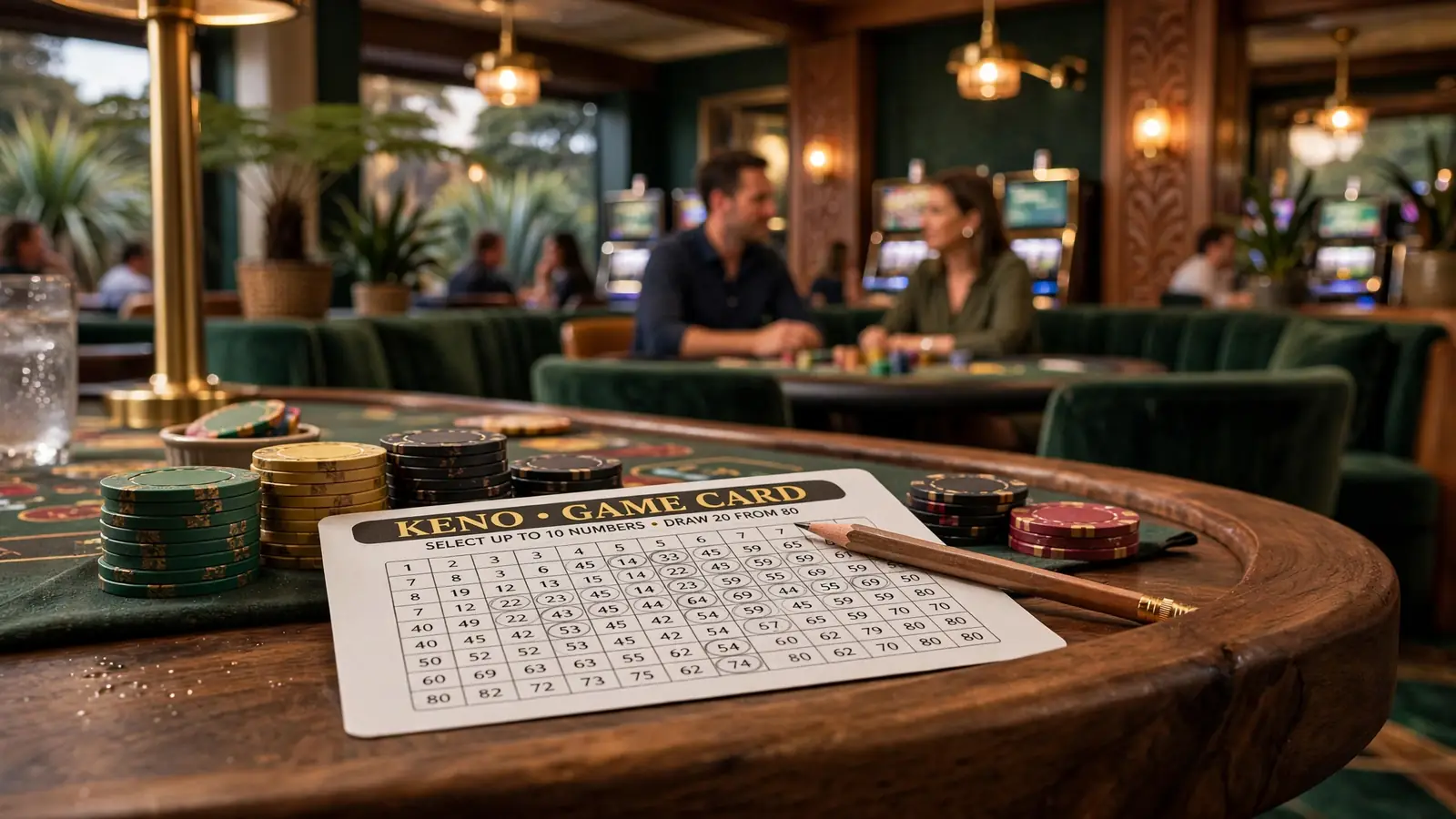
Table of Contents
- How a Keno Draw Becomes a Result
- How to Play Keno at a Casino
- How Online Keno Games Differ
- Free Keno, Bonuses and Mobile Play
- Playing Keno Online Without a Download
- Keno for Real Money: Stakes, Payouts and Limits
- Bitcoin and Keno: Check the Payment Terms First
- Why Keno Strategies Cannot Predict the Next Draw
- Checking a Keno Casino’s Status in New Zealand
- Keno Draw Times and the Prize-Claim Window
How a Keno Draw Becomes a Result
A Keno result comes from comparing the spots you selected with the numbers drawn, then applying the game’s paytable. The sequence is simple, but each part has a separate role: your selection defines what can match, the draw supplies the result, and the paytable determines whether those matches produce a prize.
A common format starts with a grid numbered from 1 to 80. You choose a set of numbers on that grid; in this version, 20 numbers are drawn. The selected numbers are often called spots. They are your entries for that round, not predictions about which numbers will appear.
Once you have chosen your spots, you set a stake for the play. The stake is the amount attached to that entry. It does not alter the numbers in the draw. Instead, it is part of the conditions under which the paytable calculates a result. The number of spots you select also matters because the paytable can treat different selection sizes differently.
The draw then produces its set of numbers. To evaluate the entry, compare that set with your chosen spots and count the matches. A number on your selection that also appears in the draw is a hit; one that does not appear is a miss. The final match count is the connection between your selection and the paytable.
Choosing a keno casino in New Zealand means finding an option that fits your preferences and gives you useful information to assess its credentials. Use these operator notes as a starting point when deciding where to play.
License: Malta Gaming Authority, licence no. MGA/B2C/370/2017 Play Grand lists a Malta Gaming Authority licence, no. MGA/B2C/370/2017. You can use this licence detail as one point of reference when considering the operator.
Payout speed: 1-3 business days Lamabet lists a payout speed of 1–3 business days. This gives you a stated timeframe to consider when reviewing its payment information.
License: Malta Gaming Authority, licence no. MGA/B2C/394/2017 N1 Casino lists a Malta Gaming Authority licence, no. MGA/B2C/394/2017. You can take this licence detail into account when assessing the operator.
Payout speed: 1-3 business days Wintino lists a payout speed of 1–3 business days. You can use this stated timeframe as part of your review.
License: Curaçao Gaming Authority, licence no. OGL/2024/165/0185 BitStarz lists a Curaçao Gaming Authority licence, no. OGL/2024/165/0185. This is a specific credential you can refer to when considering the operator.
License: Tobique Gaming Commission, licence no. 0000064 Neospin lists a Tobique Gaming Commission licence, no. 0000064. You can consider this licence information as part of your assessment.
License: 07017519840 · Payout speed: 1-3 business days Zotabet lists licence number 07017519840 and a payout speed of 1–3 business days. These details give you two concrete points to consider when reviewing the operator.
License: Tobique Gaming Commission, licence no. 0000091 7Bit Casino lists a Tobique Gaming Commission licence, no. 0000091. You can use this detail as one reference when assessing the operator.
License: Tobique Gaming Commission, licence no. 0000002 Ricky Casino lists a Tobique Gaming Commission licence, no. 0000002. This licence information gives you a concrete detail to consider when reviewing the operator.
That count alone does not tell you the prize. The paytable is the rule set that maps a particular selection and result to an outcome. It may specify which match counts qualify for a return and how the stake is reflected in any prize. For that reason, two Keno games can show the same number of hits but assign different outcomes. The rules for that specific game, rather than the label “Keno”, decide how the result is valued.
Think of the process as three linked inputs: the spots you selected, the drawn numbers, and the paytable. The selection and draw determine the match count; the paytable interprets that count. Your stake belongs to the entry and affects its financial scale according to the game’s stated rules. If you change the selection, you change which numbers can match. If you change the stake, you change the amount at risk and potentially the prize calculation. Neither change rewrites the draw itself.
This distinction helps make sense of casino Keno games that look similar on screen. A numbered grid and a draw may resemble the common format, while the prize rules differ. A specialist review notes that Keno versions can have different rules and payouts, so the title or appearance of a game is not enough to establish how it settles a result. Read the paytable attached to the game you are considering; do not assume another Keno game uses the same match-to-prize mapping.


A free version can demonstrate the relationship between spots, drawn numbers and a displayed paytable without requiring a real-money stake. It can help you see how a result is presented, but the demonstration only explains the rules configured for that particular game. It does not establish that another version uses the same grid, draw or payout logic.
When reviewing a result, separate the factual match from its financial interpretation. First identify the numbers you selected. Next identify the numbers drawn. Then count their overlap. Finally, consult the paytable for that game and apply the stake under its stated rules. Keeping those steps distinct makes it easier to spot whether an outcome follows the rules, and prevents a displayed prize from being mistaken for a universal Keno payout.
How to Play Keno at a Casino
Start by checking the game instructions and the ticket or screen layout. Identify where you select spots, enter a stake and confirm the play. The layout can make it easy to mark an unintended number, so take a moment to understand which marks are active before choosing.
You can select numbers manually by marking the spots you want on the grid. Check each selection as you make it; a missed mark or an extra one changes the entry. If you prefer not to choose numbers yourself, use a dip, which generates a random selection. A dip saves you from marking spots individually, but it does not change the chance of a result.
- Mark spots manually to ensure precision
- Use a dip for random selection
- Verify active marks before confirming
- Rely on a dip to change the result chance
- Mark numbers without double-checking
- Submit an entry without reviewing the ticket
Next, enter a stake that fits a budget you can afford to lose. Check how the displayed stake applies to the entry, especially if the game offers a multiplier or side bet: either can affect the total cost. Do not assume an option is included or switched off. Read its label and the game rules before proceeding.
Before confirming, review the complete ticket or entry. Check that the selected spots are the ones you intended, that the stake is correct, and that any optional feature is set the way you want. If anything is wrong, correct it before submitting. Once confirmed, the entry is the one that will be used for the draw; do not rely on being able to edit it afterwards.
After the draw, compare the numbers on your entry with the numbers drawn, then use that game’s paytable to determine the result. Keep the ticket if you are playing with a printed one, and check that the recorded selection and stake match what you chose. For a screen-based entry, make sure you are looking at the confirmed play rather than an unfinished selection.
The useful habit is a brief check at each stage: selection, stake, optional features, and confirmation. It catches input errors without changing the game’s underlying randomness. A manually chosen set and a dip are simply two ways to fill the entry; neither makes a particular outcome more likely.


How Online Keno Games Differ
The word “Keno” identifies a family of games, not a single set of rules. Traditional New Zealand Keno uses a grid of 80 numbers and draws 20 balls. An online version may use a different grid, draw size or result schedule, so the traditional format is a useful comparison point, not a rule you can assume applies to every game.
A specialist review describes online Keno games as differing in draw frequency, rules and paytables. That means two games can produce results on different schedules and interpret the same number of matches differently. In one version, a particular match count may correspond to a listed prize; another version may assign it a different prize or no prize. The result is therefore not just the numbers drawn: it is those numbers evaluated under that game’s rules and paytable.
The selection range can change too. A specialist review also identifies selectable spot counts, draw sizes, stake limits and payouts as variables between Keno games. If one game lets you select a different number of spots from another, the available match outcomes and the rows you need to consult on the paytable may differ. A different draw size changes the pool of numbers being compared with your selection. Do not carry assumptions from one game to another simply because both use the Keno name.
Draw frequency affects when a result is produced, not what a given result means. A game with faster rounds can return results more often than a traditional draw schedule, but its prize calculation still depends on its own rules. Check whether the displayed result is final for that round and which paytable applies; a familiar-looking grid does not establish that the game follows traditional draw timing or prize tiers.
Online Keno games can vary in draw frequency, rules, and paytables, meaning a particular match count may correspond to different prizes across different games.
Paytables are the key to interpreting online casino Keno results. They connect the number of matches to the prize for the selected spots and stake. Read the table for the exact game before treating a match count as a win or estimating its value. A prize depends on both the matches and the game’s paytable; the drawn numbers alone do not tell you the payout.
Also check how the game presents stake options and any features that change a round’s cost or prize calculation. The relevant settings belong to the specific game, so a stake or payout assumption from another version may not transfer. If the rules use terms or symbols that are not clear, resolve their meaning in the game information before relying on a result.
Searches for online Keno slots can blur the distinction between a Keno game and other casino games. The label or location in a casino lobby does not establish that a title uses traditional Keno rules. Treat each title as its own game: identify its selection range, draw process and paytable rather than judging it by category labels.
The same caution applies to online casinos with a Keno tournament. A tournament is a separate competition format, not a feature that follows automatically from Keno rules. Its scoring, eligibility and prize conditions would need to be set out in the event terms. Do not assume that a tournament is available, or that its standings use the ordinary prize table, unless those details are published for that event.
For any online version, compare the rules that determine how a round runs and how its result is paid. Similar names or graphics do not make two games equivalent.

Free Keno, Bonuses and Mobile Play
Free play is useful for inspecting a Keno game before you decide whether to risk money. It lets you see how the number grid is presented, how a selection is entered, where the stake and result appear, and how the game explains a prize. Treat it as a way to learn the interface and read the rules, not as evidence that a later real-money session will produce the same result.
A free session can also help you check whether you understand the game’s controls. Try selecting numbers manually, then look at any available quick-pick option to see how the selection is displayed. If the game offers a multi-card layout, such as four cards, inspect each card before starting: confirm which selections belong to which card and how the stake is applied. The layout alone does not establish the game’s rules or payout structure, so use the paytable and rules shown for that specific game.
Before starting a free round, check whether the game is genuinely in a practice mode. Some interfaces can display a balance or promotional credit alongside the game, and those are not necessarily the same thing as unrestricted play. Read the screen labels and terms so you know whether a session is for practice, uses a bonus, or involves real-money play. If the mode is unclear, do not assume that a button or balance means what you expect it to mean.
Read bonus terms before opting in
A bonus can change how Keno wagers are treated, even when the game itself appears unchanged. The operator’s own bonus terms are the place to check eligibility, wagering requirements, game contribution, expiry and any maximum withdrawal. These conditions can vary between offers, so a description on a promotional banner is not a substitute for the full terms.
Attention Keno may have limited contribution toward wagering requirements or be excluded from certain bonuses entirely.
Pay particular attention to whether Keno is eligible and how its wagers count. A bonus may limit the amount of wagering that Keno contributes towards a requirement, or exclude the game under particular conditions. If the terms do not clearly say how Keno is treated, do not assume that every stake will count in full. You should also check whether opting into an offer changes the conditions attached to your balance or any resulting withdrawal.
Do not judge a bonus by its headline alone. A larger displayed balance does not make the offer risk-free cash, and a bonus does not remove the possibility of losing the money you wager. Before accepting, make sure you understand what you must do to meet the conditions and what restrictions apply if you stop playing or request a withdrawal. If the terms do not fit your intended play, declining the offer is a valid choice.
Free play is not a reliable way to test whether a bonus will be easy to clear. Practice results do not establish what will happen in real-money play, and the bonus conditions—not the appearance of the game—determine how qualifying wagers are counted. Keep those two questions separate: first learn the controls in free play, then assess the offer from its written terms.

Check the game on a mobile screen
On a phone or tablet, the main risk is not a different set of odds simply because the screen is smaller; it is making an entry or reading a result incorrectly. Before confirming a round, check that every intended selection is visible and that the displayed stake matches what you meant to enter. If the game has several cards, review each one rather than assuming a tap affected only the card you had in mind.
Look for controls that may be less obvious on a compact screen. A touch can select a number, clear a selection, or change a setting, so pause after each change and verify the updated display. If the game includes an optional multiplier or side feature, check whether it adds a cost before enabling it. Do not confirm a round while a menu, pop-up or overlay obscures the selection or stake.

Connection interruptions can also leave you uncertain about whether a round was submitted or completed. Check the game’s displayed status and result before trying again; repeating an action without knowing what happened could create an unintended entry. If the screen freezes or the result is unclear, stop interacting until the game state is visible. The goal is to confirm what the interface records, not to infer it from a tap.
A published RTP is a theoretical long-run value for a particular paytable. It does not predict the return from one session, and a free-play session cannot turn it into a forecast. Use practice mode to understand the presentation and controls, use the written terms to assess a bonus, and set a spending and time limit before real-money play. Never chase losses or use money needed for essentials.
Playing Keno Online Without a Download
A browser-based Keno game runs through a website rather than requiring you to install a separate app or program. You open the game page, wait for its controls and display to load, then use the available options in the browser. That describes how you access the game; it does not tell you how the game works or whether it is suitable for your device.
“No download” is therefore a technical description, not a statement about the rules. Two browser games can use different number grids, draw schedules, selectable spots and paytables. A specialist review notes that online Keno games can vary in draw frequency, rules and prize tables. Check the game’s own rules and paytable rather than assuming that a familiar name or layout means the same game is being offered.
The same applies to features displayed beside the game. A specialist review describes some Keno versions as offering quick picks, faster draws, multipliers or jackpots. These options can affect the cost of a play or the way a prize is calculated. Before confirming an entry, check whether a feature is selected and what it changes; the fact that the game loads in a browser does not make those conditions standard.

If you are looking for a Keno game associated with a station casino, confirm that the venue actually provides online access to that game. A name or link alone does not establish that it is the venue’s game, that its rules match a traditional Keno draw, or that it is available to you. Read the game information on the page where you intend to play, including its provider and terms, before entering any details.
A browser session can also behave differently across devices. If controls are cut off, text is difficult to read or the page stops responding, do not guess which option is selected. Reload the page or close it and check the game again before placing an entry. This is particularly important where the interface displays extra features next to the main Keno controls.
No-download access is useful when you want to avoid installing software, but it does not verify the operator, the game’s payout structure or the conditions attached to play. Treat access, game rules and operator information as separate checks. Before real-money play, check the operator’s identity, licence details, bonus restrictions and payment terms, then set a spending and time limit. A browser window changes how the game reaches your screen; it does not answer those other questions.

Keno for Real Money: Stakes, Payouts and Limits
In real-money Keno, the stake is the amount attached to a play; the prize is determined by how many selected spots match the draw and by the game’s paytable. A match count on its own does not tell you what you will receive. The paytable maps each result to its payout, and that mapping can differ between games. Check it before wagering, including any rules that affect how the stake or prize is calculated.
A published return to player (RTP) figure describes the theoretical return across a very large number of plays under a particular paytable. It is not a forecast for your next game or a guarantee that a session will return a certain amount. Short sessions can produce outcomes far above or below that long-run figure. The RTP is meaningful only when you know which game and paytable it applies to; it cannot be transferred to another Keno version just because the games look similar.
Never chase losses or use money needed for essentials to fund your Keno stakes.
That distinction matters when comparing online Keno games for real money. Look at the actual rules and payout table for the game you intend to play, rather than relying on a general RTP label or a description of the game. Confirm how your chosen stake relates to the listed prizes and whether the displayed figure applies to the selected version. If the paytable or its basis is unclear, you cannot make a sound comparison of potential returns.
Set a spending and time limit before you start. Choose a stake that fits a budget you can afford to lose, and do not increase it to recover losses. A run of low prizes does not make a larger return due, and a large prize does not change the cost of the next play. Treat each stake as a new financial decision, not as money that the game owes back.
Before real-money play, check the operator’s identity, licence details, bonus restrictions and payment terms, then review the game’s paytable. Do not assume that a casino has a New Zealand licence: check its current regulatory status before depositing. Keep the amount you are willing to spend separate from money needed for essentials. If you find yourself exceeding your limit or chasing losses, stop rather than extending the session.

Bitcoin and Keno: Check the Payment Terms First
A site that lists Keno and Bitcoin does not necessarily allow you to use Bitcoin for every stage of play. The payment page and the terms for your account should make clear whether Bitcoin is accepted for deposits, withdrawals, or both. Check those details before transferring funds; an advertised payment option alone does not establish how it works for Keno.
Read the payment instructions alongside the account and withdrawal terms. Confirm which currency your balance will use, whether a Bitcoin deposit is converted, and what steps are required to withdraw. Check whether the payment method must be used for withdrawals and whether identity checks or other account requirements apply. If the wording leaves any of these points unclear, ask the operator for an explanation before depositing.
Also check that the Bitcoin option is available to customers in New Zealand, rather than assuming that a payment method displayed on a general website applies to your account. Payment options and conditions can change, so rely on the operator’s current terms, not an old review or a screenshot. Make sure the recipient details and any instructions shown during the transaction match the operator’s published guidance.
Payment compatibility does not tell you how the Keno game itself works. Specialist game reviews note that online Keno titles can differ in draw frequency, paytable and rules. Before wagering, open the specific game’s rules and confirm that you understand its spot choices, stake options and prize table. A Bitcoin payment method does not make one Keno version equivalent to another.
New Zealand Regulatory Framework
New Zealand’s Online Casino Gambling Act 2026, effective 1 May 2026, establishes a domestic licensing regime. The Department of Internal Affairs oversees the framework, while the Gambling Commission handles licensing applications and conditions.
Regulatory status is a separate check from payment support. New Zealand’s Online Casino Gambling Act 2026 came into force on 1 May 2026 and created a transition period for online casino services already operating in the country before that date. The Gambling Commission handles casino licensing applications, while the Department of Internal Affairs oversees the framework. Do not infer that an operator has a New Zealand licence simply because it accepts New Zealand customers or Bitcoin. Check its current regulatory information and any applicable licence record before depositing.
Before real-money play, check the operator’s identity, licence details, bonus restrictions and payment terms. Set a spending and time limit in advance, use only money you can afford to lose, and do not chase losses. These checks address different risks: the payment terms explain how funds move, the game rules explain how Keno outcomes are paid, and regulatory information helps you understand the operator’s status.
Why Keno Strategies Cannot Predict the Next Draw
A Keno strategy can change which numbers you select, but it cannot change how a random draw is produced. If each draw is independent, its outcome does not depend on your choices or on what appeared previously. The selection method affects your ticket, not the probability mechanism behind the draw.
Patterns can look persuasive in a record of results. A number may appear often, or may not have appeared for a while. Neither observation makes it more likely to appear next. Treating past results as a forecast assumes that the draw is correcting an imbalance or following a sequence. An independent draw does neither: it starts afresh.

The same limit applies to systems based on dates, personal numbers, or groups of numbers chosen according to a rule. These methods can make selection feel structured, but they do not give the chosen spots an advantage. A “hot” number is not strengthened by appearing before, and a “cold” number is not owed a turn.
A number generator has a narrower purpose. It selects spots for you, which can save you from choosing them manually. It does not analyse the upcoming result or identify numbers that are more likely to be drawn. Quick selection and personal selection are simply different ways to form a set.
Free casino Keno can let you observe how a game records selections and displays results, but free play does not make a number system predictive. Nor does a winning result prove that a strategy works: a result can match a selection by chance. To assess a claim about a strategy, separate the selection rule from the draw itself. Ask whether the rule changes the draw’s operation or only changes the numbers on the ticket. For Keno, it is the latter.
This distinction is useful when a strategy is presented with charts, generators, or lists of previous results. Those tools may organise information or automate a choice; they do not establish an improved chance on the next independent draw. Treat them as selection aids, not predictions, and do not increase a stake because a pattern appears convincing.
Checking a Keno Casino’s Status in New Zealand
A Keno game’s rules do not tell you whether the website offering it is authorised to operate. Check the operator’s identity and current regulatory information separately from the game description, before depositing. Do not assume that a casino has a New Zealand licence simply because it accepts New Zealand customers or describes itself as licensed overseas.
From 1 May 2026 to 1 December 2026, a transition period allows previously operating online casinos to continue services under specific transitional provisions.
New Zealand’s framework is changing under the Online Casino Gambling Act 2026, which came into force on 1 May 2026. The Act creates the country’s first domestic licensing regime for online casino gambling. The Department of Internal Affairs oversees the framework, while the Gambling Commission considers casino licence applications and decides whether to grant them. It also handles approvals for changes to licence conditions. These are distinct roles: the Department is the primary gambling regulator, and the Commission makes licensing decisions.
The transition period runs from 1 May 2026 to 1 December 2026. During that window, online casinos that were already providing services to people in New Zealand before 1 May may continue operating, subject to the Act’s transitional provisions. That permission is not the same as holding a licence under the new regime. The full licensed system is not expected to be fully operational until 2027, so the regulatory status you see during the transition needs to be read in that context.

Before the Act, the Gambling Act 2003 did not permit online casinos to be based in New Zealand. Offshore online casino services were not licensed or supervised by a New Zealand regulator, and customers wagering with those sites had no domestic government recourse. The new law changes the framework, but it does not make every offshore site a New Zealand-licensed casino. A foreign licence and a New Zealand licence are not interchangeable.
When checking a site, identify the legal entity that operates it, then compare its stated status with current information from the relevant New Zealand regulatory bodies. Look for clear details about the licence and the entity it covers. A general claim such as “regulated” is not enough to establish which regulator issued the licence, what company holds it, or whether the licence applies to the website you are using. If those details are unclear or cannot be checked, do not treat the claim as confirmation of New Zealand authorisation.

A specialist market review describes the licensing process as underway. That description should be understood alongside the legal transition dates: the regime has been established in law, but its full operation is expected later. Do not infer that an operator has received a licence simply because applications are being handled or because the operator has served New Zealand customers during the transition.
This distinction matters when comparing Keno casinos. A familiar brand, an available Keno game, or access from New Zealand does not by itself establish the operator’s regulatory position. Check the operator’s identity and licence details against current regulatory information before depositing, and make your decision based on the status that applies at that time.
Keno Draw Times and the Prize-Claim Window
Traditional Keno in New Zealand has four scheduled draws each day: 10 am, 1 pm, 3 pm and 6 pm NZST. The stated times are in New Zealand Standard Time, so check the applicable local time when planning around a draw, particularly if you are outside the country.

Each draw takes 20 balls from a pool of 80. The schedule tells you when results are produced; it does not mean that casino Keno games follow the same timetable. Online versions can run on different schedules, so use the game’s own information if you are playing a digital game.
A result and a claim are separate steps. If you hold a traditional Keno ticket, keep it and check the result through the relevant official channel. Do not assume that a prize remains claimable indefinitely: the claim period matters even after the draw has finished.
A specialist review reports a 12-month claim window from the draw date. That is a secondary source, not confirmation of the current official rule. Before relying on that period, check the applicable Keno rules or ask the responsible provider how and by when a prize must be claimed. If a ticket appears to be a winner, make that check promptly rather than waiting until near a reported deadline.
Are there any strategies for playing Keno?
You can choose your numbers yourself or use a random dip, but neither approach improves your odds. Set a stake you can afford to lose and check the game’s rules and paytable before playing.
Can a Keno strategy guarantee a win?
No. Each draw is random, and neither number patterns nor previous results can guarantee a win or improve the probability of the next draw.
How many numbers are drawn?
In traditional New Zealand Keno, 20 numbers are drawn from a set of 80. Online versions may use different formats.
What is a spot?
A spot is a number you select on the Keno grid for a play. Your result depends on how many of your selected spots match the drawn numbers and on that game’s paytable.
Can you play Keno online?
Yes, online Keno games are available, though their rules, draw frequency and paytables can differ from traditional New Zealand Keno.
How often are Keno NZ draws held?
Traditional Keno in New Zealand has four draws daily: at 10 am, 1 pm, 3 pm and 6 pm NZST.
Created by the ”Casino Bonus Tips NZ” editorial team.