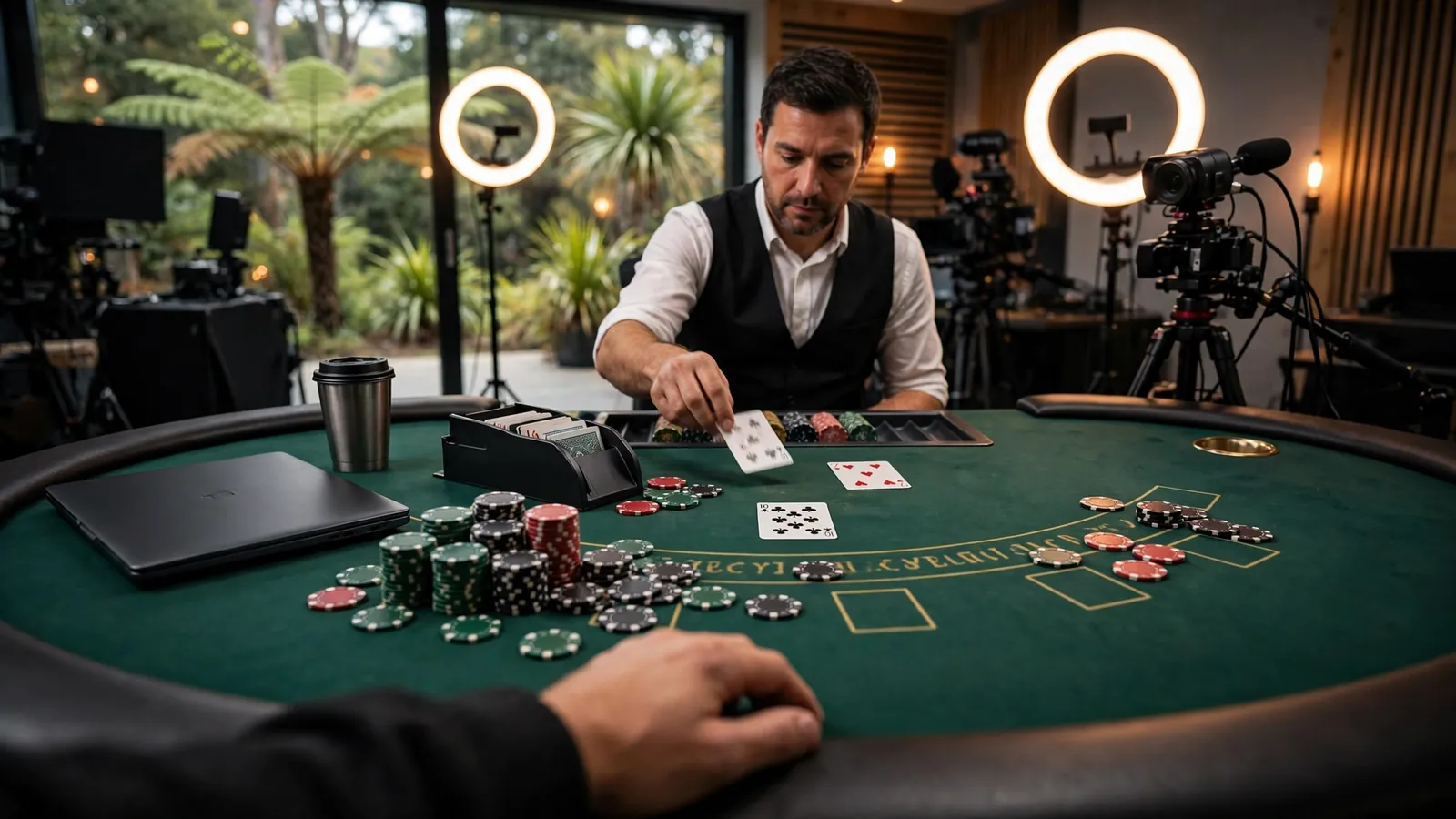
Blackjack Strategies for New Zealand Players
 Available in US
See how hand totals, the dealer’s visible card, game rules and format affect decisions such as hitting, standing, doubling and splitting.

Table of Contents
- How Blackjack Decisions Work
- Reading and Using a Basic Strategy Chart
- How Deck Count and Table Rules Change Your Decisions
- Practising Until the Decisions Become Consistent
- Blackjack Switch Requires a Different Strategy
- Manage Your Bets Without Relying on Betting Systems
- What Blackjack Strategy Means in 2026 for New Zealand Players
- Card Counting, Optimal Play, and Team Strategy
- Advanced Strategy Depends on the Game Format
How Blackjack Decisions Work
Blackjack is a contest between each player and the dealer, not a competition among the players at the table. Your aim is to finish with a hand closer to 21 than the dealer’s hand without going over 21. If your total exceeds 21, you bust and lose the hand, regardless of what the dealer later draws. If the dealer busts, any player whose hand has not already busted wins.
A hand’s value comes from adding its cards. Number cards count at face value, while jacks, queens and kings count as 10. An ace can count as either 1 or 11, whichever value keeps the hand from exceeding 21 when possible. That flexibility makes some hands change character as cards are added. For instance, an ace with a 6 can be treated as 7 or 17. If you draw a card that would push the total past 21 when the ace counts as 11, the ace can instead count as 1.
Your decisions happen after you receive your starting hand and see the dealer’s visible card. The dealer’s card matters because it gives you information about the hand you are trying to beat, but it does not reveal the dealer’s final total. You must choose an action using what is known at that point, while accounting for the possibility that either hand will change.
The available actions
Hit means taking another card. You can choose to hit when you want to improve your total, but every additional card carries the possibility of busting. The choice is not simply a matter of whether your current total looks low: the dealer’s visible card also affects the situation. A hand that appears weak against one dealer card may be less urgent to improve against another.
Stand means keeping your current total and taking no more cards. You are accepting the hand as it stands. That does not end the round for everyone: the dealer still has to complete their hand under the table’s rules, and the result is determined by comparing the final hands. Standing avoids the immediate risk of busting from another card, but it also leaves your total unchanged.

Double down is a decision to increase your commitment to the hand and take a single additional card before standing. It can be useful when the position favours making one controlled draw rather than taking cards repeatedly. Because the action limits what you can do afterward, it is not interchangeable with an ordinary hit. The exact terms for doubling are set by the table, so check what the game permits before relying on the option.
Split is available when your first two cards have the same value. You separate them into two hands and play each hand separately, with the permitted play determined by the table’s rules. Splitting therefore changes one starting hand into two decisions, each of which can develop differently. It does not make either hand a guaranteed winner; it gives you separate opportunities to continue play.
Some games also permit surrender, which lets you give up the hand under specified conditions rather than continue. It is not available at every table. The four central actions—hit, stand, double down and split—are the basic decision set, while any additional option depends on the game you are playing.
Decisions are made in sequence
A useful way to understand a turn is to separate the information you have from the action you choose. First, identify your hand total, including whether an ace can still count as 11 without causing a bust. Next, note the dealer’s visible card. Then consider the legal actions available at that point. Your choice changes what can happen next: hitting adds a card, standing fixes your total, doubling restricts you to one further card, and splitting creates separate hands.
The round continues until players have finished their hands and the dealer completes theirs. A player who has already busted cannot recover by waiting for the dealer. A player who stands remains in contention, but must still compare their total with the dealer’s completed hand. This sequence explains why a decision is not judged only by its immediate outcome. A hit can be reasonable and still produce a bad result; a stand can lose even when it was the appropriate choice given the information available.
- Identify your hand total and ace flexibility
- Note the dealer’s visible card
- Consider all legal actions available
- Judge a decision only by its immediate outcome
- Assume a hit is always wrong if it results in a bust
- Change choices based on whether the previous hand won
The mechanics apply whether you play at a physical table or through an online game. What matters for each decision is the hand in front of you, the dealer’s visible card, and which actions the game allows. Strategy builds on this structure: it provides a consistent way to select an action rather than changing your choice merely because the previous hand won or lost.
Reading and Using a Basic Strategy Chart
A basic strategy chart turns your two inputs—your hand and the dealer’s visible card—into an action. It is a lookup tool, not a prediction of the next card. To use one, first identify the type of hand you hold, then locate the dealer’s upcard, and follow the instruction where the matching row and column meet.
Classify your hand first
Charts commonly separate hands into hard totals, soft totals and pairs. A hard total has no ace counted as 11 without taking the hand over 21. A soft total contains an ace currently counted as 11, so its value can fall if you draw a card: the ace can instead count as 1. A pair is two cards of the same rank, which may give you the option to split them, depending on the table rules.
This classification matters because hands with the same current total can have different options. For instance, a soft hand can often take a card without the same immediate risk of busting as a hard hand. Do not choose a row by total alone if the chart distinguishes soft hands or pairs.

Find the dealer’s upcard
After identifying your hand category and total, read across to the column for the dealer’s upcard. The cell at that intersection gives the chart’s recommended action for that exact situation. Follow the chart’s key: common abbreviations refer to hitting, standing, doubling down, splitting or, where available, surrendering.
If a recommended action is not permitted at your table, use the chart’s stated fallback if it provides one. Otherwise, do not assume that an unavailable move is allowed; the table’s rules determine which choices you can make. A chart is useful only when its instructions correspond to the options offered in the game.
The dealer’s upcard is not a forecast of the dealer’s final hand. It is one of the inputs used to select a consistent response. The chart therefore prevents you from treating the same player hand as an identical decision in every situation: the dealer’s visible card can change the recommended action.
Check the chart’s assumptions
A blackjack basic strategy card is not automatically suitable for every game. Before applying it, check that it is designed for the table you are playing, including whether the dealer hits or stands on soft 17 and whether surrender is available. These conditions can change which cell applies. A chart that assumes a different rule set may still look clear while giving you mismatched instructions.
Using a Strategy Chart
Determine if you have a hard total, a soft total, or a pair.
Locate the column on the chart that matches the dealer’s visible card.
Follow the row and column to the intersecting cell to find the recommended move.
Ensure the recommended action is permitted by the specific rules of your table.
Use one chart as a decision reference rather than mixing recommendations from different charts. When the game displays a rule or action that the chart does not cover, pause and find a chart that does. This is especially important if the interface uses short labels: confirm what each label means before placing a decision.
A basic strategy chart guides play; it does not control the cards or guarantee a winning session. It also does not tell you how much to wager. Keep the playing decision—hit, stand, double, split or surrender—separate from the amount you choose to bet. Insurance is a separate wager, not a substitute for following the chart’s instruction for your hand.
In a tournament, basic strategy can still help you make consistent hand decisions, but it does not by itself address tournament-specific objectives. Treat it as a reference for the blackjack hand, not as a complete plan for competing.
How Deck Count and Table Rules Change Your Decisions
A basic-strategy chart is not a universal set of instructions. It is built around a particular combination of deck count and table rules. If the game differs from the conditions behind the chart, some recommended actions may no longer be the best fit. Before using one, check the table information and match the chart to the game you are actually playing.
Deck count is one part of that match. A chart prepared for a single-deck game may not give the same recommendations as one designed for a game using multiple decks. The same applies to a double-deck game: its chart should be selected for that format rather than treated as interchangeable with a multi-deck chart. The chart’s heading or notes should identify the conditions it covers. If they do not, you cannot tell reliably whether its recommendations apply.

This does not mean that every hand changes when the deck count changes. It means you should not assume that a chart remains correct just because its layout and hand labels look familiar. Where the chart’s assumptions differ from the table, check the relevant decision rather than silently carrying over the instruction.
The dealer’s treatment of soft 17 is another important condition. A soft 17 is a hand containing an ace counted as 11 that totals 17. The dealer may be required to hit it or to stand on it, depending on the game. That rule changes the dealer’s possible outcomes, which can affect the player’s best action in some situations. Look for the rule stated explicitly; do not infer it from the game’s name or appearance.
Surrender rules also matter. If surrender is available, a chart may include it as an option for certain hands. If the table does not offer surrender, that instruction cannot be followed, and you need a chart that accounts for its absence. The timing and availability of surrender should be clear in the table rules before you rely on a recommendation.
The blackjack payout is another chart condition, not a cosmetic detail. A specialist review describes natural blackjack payouts of 3:2 at some tables and 6:5 at others; treat those figures as reported examples, not as a fixed rule for every game. A different payout changes the value of a natural blackjack and can therefore change the strategy suited to the table. Check the payout shown in the rules rather than assuming it from the game title.
Table Rule Variables
Deck count, soft-17 treatment, surrender availability, and blackjack payout all work together to determine the correct strategy chart.
Deck count, soft-17 treatment, surrender availability and blackjack payout work together. A chart that matches only one of these conditions may still be unsuitable if the others differ. Use the table’s stated rules to identify the correct chart, and switch charts when you move to a game with different conditions.
Practising Until the Decisions Become Consistent
Practice is useful when it tests whether you can make the same decision from the same information, not whether a short run of hands produces a win. A sound process can still be followed by losing hands. Its value is that it reduces avoidable errors; it does not guarantee a particular result.
Choose a strategy reference for the game you intend to practise, then use it consistently during a session. For each hand, identify your cards and the dealer’s upcard, decide what action the strategy calls for, and only then check the reference. This order matters: looking up the answer first can create the impression that you know it when you are only recognising it.
When your decision differs from the reference, record the hand and the action you chose. Note whether the error came from reading the hand incorrectly, forgetting a rule, or misremembering the recommended action. These are different problems. A misread hand calls for slower identification; a forgotten rule calls for reviewing the game’s instructions; a misremembered choice calls for focused repetition.

Build a repeatable review routine
Keep practice sessions narrow enough that you can pay attention. Work through hands without rushing, say the relevant information to yourself, and make a decision before checking. Review mistakes after the hand rather than changing your approach in the middle of a sequence. If you find yourself guessing, pause and return to the reference instead of treating a guess as a learned rule.
A record of decisions can reveal whether errors are recurring. Group them by the kind of situation that caused them, then practise those situations again. The goal is not to memorise isolated hands as disconnected answers. It is to recognise the features that determine the action, so that a changed card or dealer upcard leads you to reassess rather than repeat a response by habit.
You can practise without wagering real money. A simulated hand still tests whether you can identify the situation and apply your chosen strategy. Online RNG games use software shuffles and permit faster play than live-dealer games, so the pace may differ. Faster hands are not automatically better practice: if you stop checking your reasoning, speed can reinforce mistakes.
What “perfect” can and cannot mean
People looking for a perfect basic strategy are generally looking for a consistent, mathematically grounded way to choose actions under stated game conditions. “Perfect” does not mean that every hand wins, nor that one set of decisions applies unchanged to every blackjack game. The strategy has to correspond to the rules being played, and those rules can affect the correct choice.
Attention A premium label does not make a strategy error-proof; always compare recommendations with the actual table rules.
Nor does adding a premium label make a strategy error-proof. Before relying on any guide, establish what game and assumptions it covers, and compare its recommendations with the actual rules. Keep the practice task separate from betting decisions: increasing a wager after an incorrect choice does not correct the choice.
Progress means that you can explain why you selected an action and reproduce that decision when the same situation appears again. If you cannot explain it, consult the reference and practise the reasoning once more. Consistency is a skill you can test; guaranteed results are not.
Blackjack Switch Requires a Different Strategy
A standard blackjack chart is a set of decisions for a particular game, not a universal set of instructions. Blackjack Switch is a variant, so do not assume that a chart for ordinary blackjack applies unchanged. The rules can alter which outcomes are possible and how valuable a decision is; variants can therefore change both strategy and the house edge.

The name alone is not enough to identify the rules at a particular table. Before using a blackjack basic strategy table, read the game’s rules and confirm that the chart was prepared for that version. Pay attention to how the variant defines a hand, what choices it gives you, and how it resolves hands against the dealer. Those details determine whether a recommendation from a standard chart still makes sense. If the rules are unclear, do not fill in the gaps by assuming the game works like familiar blackjack.
This matters because a strategy recommendation depends on the consequences of each available action. A chart may advise a move because, under its assumptions, that move produces a better expected result than the alternatives. Change the rules, and the comparison can change too. A decision that is correct in ordinary blackjack may no longer be the best response in a variant, even when the cards in front of you look similar.
Treat a basic strategy guide as a match only when its stated game rules correspond to the table you are playing. If the guide does not identify the variant, or its description does not line up with the game’s rules, it cannot reliably settle a variant-specific decision. Avoid combining instructions from different charts: one may assume ordinary blackjack while another covers a different ruleset. Their recommendations can conflict because they are solving different games.

The same caution applies when someone describes a particular approach as the best blackjack strategy. “Best” has meaning only in relation to the rules and the objective being assessed. A strategy cannot be judged from its name alone, and a chart cannot promise a particular result for an individual hand or session. Basic strategy provides a structured way to choose; it does not remove the effect of the variant’s rules or the uncertainty of play.
For Blackjack Switch, start with the table’s own explanation of the game, then use guidance explicitly written for that version. If you cannot verify that a chart matches, treat it as general background rather than instructions for your next decision. The odds of winning with basic strategy depend on the game being analysed, so figures or conclusions for ordinary blackjack should not be transferred automatically to Switch.
Manage Your Bets Without Relying on Betting Systems
Your playing decision and your bet size solve different problems. Choosing to hit, stand, double or split determines how you play the hand under the table’s rules. Choosing how much to stake determines how much money you expose to that hand. A sound playing decision cannot make an unsuitable stake affordable, and changing your stake does not repair a poor playing decision.
Set a gambling budget before you begin: decide what you can afford to lose, and stop when that money is gone. Do not add funds or raise your stake to recover losses. A losing run does not make a win due, and a dealer showing a weak card does not turn a larger bet into a reliable way to profit. A so-called dealer-bust betting strategy still depends on uncertain outcomes; the dealer’s chance of going over 21 is not a guarantee about the next hand.
Betting progressions change the size and timing of your wagers, not the cards dealt. In a 1-2-3-5 progression, for instance, the stake rises through a set sequence after specified results. That pattern cannot ensure a win: a run of losses can use up your budget, while a win may not recover earlier losses. It can also push your next wager beyond the amount you intended to risk. If you use any stake pattern, understand its rules in advance and keep every wager within your preset limit; do not treat the sequence as a source of an advantage.

The same distinction helps answer whether blackjack strategy works. Consistent decisions can reduce avoidable errors, but they cannot dictate the cards or guarantee a profitable session. Stake control limits the amount you choose to put at risk; it does not change the outcome of a hand. Keep those expectations separate rather than increasing bets because you believe correct play must eventually produce a win.
Also account for terms that affect the value of play. Blackjack may contribute differently from other games toward wagering requirements, and maximum-bet rules may apply while you are meeting them. Before playing with real money, read the fine print and bonus conditions on trustworthy sites and casinos. If those terms limit how you may bet, a progression can conflict with them as well as with your budget.
Insurance is another wager, separate from the decision about your hand. Most players should avoid treating it as routine protection: it adds exposure rather than making the main hand safer. Decide your stake before the deal, keep it within your budget, and do not let a betting system, a bonus condition or a recent loss set a higher limit for you.
What Blackjack Strategy Means in 2026 for New Zealand Players
When you put blackjack strategies into practice, choosing where to play is part of making an informed decision. Use this list as a reference point and consider the details provided for each operator.
License: Malta Gaming Authority, licence no. MGA/B2C/370/2017 You can note that Play Grand lists a Malta Gaming Authority licence, no. MGA/B2C/370/2017.
Payout speed: 1-3 business days Lamabet lists a payout speed of 1–3 business days, a detail you can consider when reviewing your options.
License: Malta Gaming Authority, licence no. MGA/B2C/394/2017 You can note that N1 Casino lists a Malta Gaming Authority licence, no. MGA/B2C/394/2017.
Payout speed: 1-3 business days Wintino lists a payout speed of 1–3 business days, which gives you a stated timeframe to consider.
License: Curaçao Gaming Authority, licence no. OGL/2024/165/0185 You can note that BitStarz lists a Curaçao Gaming Authority licence, no. OGL/2024/165/0185.
License: Tobique Gaming Commission, licence no. 0000064 Neospin lists a Tobique Gaming Commission licence, no. 0000064, for you to take into account.
License: 07017519840 · Payout speed: 1-3 business days Zotabet lists the identifier 07017519840 and a payout speed of 1–3 business days. These are the provided details you can use when reviewing it.
License: Tobique Gaming Commission, licence no. 0000091 You can note that 7Bit Casino lists a Tobique Gaming Commission licence, no. 0000091.
License: Tobique Gaming Commission, licence no. 0000002 You can note that Ricky Casino lists a Tobique Gaming Commission licence, no. 0000002.
A blackjack strategy is a repeatable way to make decisions at the table, not a promise that a particular session will end in profit. You can use a suitable strategy chart to guide your actions, then check that its assumptions match the game you are playing. Keep betting decisions separate: increasing a wager after a loss does not change the cards or improve the decision available on your next hand.
Searches for systems such as “blackjack 212” or a strategy of doubling after a loss often describe betting patterns rather than ways to play a hand. A betting sequence cannot make an unfavourable hand favourable. Set a budget before playing, avoid chasing losses, and read the rules and fine print before risking money. If a promotion has wagering requirements, check how blackjack contributes to them and whether maximum-bet rules apply while you meet those requirements.
New Zealand’s regulatory position is also changing during 2026. The Online Casino Gambling Act 2026 took effect on 1 May, establishing the country’s first domestic licensing framework for online casino gambling. The Department of Internal Affairs is New Zealand’s primary gambling regulator and oversees that framework. The Gambling Commission handles casino licence applications: it hears and decides them, issues online casino licences, and approves changes to licence conditions.
Licensing Risk
Do not treat a claim of local licensing as proof without checking the operator’s status, as the full licensing regime is not operational until 2027.
The new system does not mean every online casino serving New Zealand is already locally licensed. Providers that were operating in New Zealand before the Act took effect may continue during a transition that began on 1 May 2026 and ends on 1 December 2026, subject to the Act’s transitional provisions. The full licensing regime is not expected to be operational until 2027. Before the new law, offshore online casino gambling was not licensed or supervised by a New Zealand regulator, and customers had no domestic government recourse.
For you, this makes two checks distinct. First, assess the blackjack game itself: its rules determine which strategy applies. Second, understand the operator’s legal position at the time you play; a strategy chart cannot establish that. Do not treat a claim of local licensing as proof without checking the relevant status, and do not assume that the transition has already become the full licensing system. Licensed operators will have stricter age and identity verification duties, while advertising by licensed operators is subject to tight rules and sponsorships are prohibited.

Card Counting, Optimal Play, and Team Strategy
Basic strategy and card counting answer different questions. Basic strategy uses your hand and the dealer’s visible card to select an action. Card counting adds an estimate of which cards remain available, based on cards already seen. That estimate can indicate whether the remaining mix is relatively favourable to the player or to the dealer. It does not reveal the next card, and it cannot turn an uncertain result into a certain one.
The underlying card values help explain what a count is trying to measure. Number cards retain their face values, face cards count as 10, and an ace may count as 1 or 11. A high share of tens and aces among the unseen cards can affect the likelihood of natural blackjacks and the outcomes of some player decisions. A count compresses information about exposed cards into a running estimate; it is not a prediction of a particular hand.
What a count can and cannot tell you
A simple counting system classifies cards into groups and assigns each group a relative effect on the count. As cards are revealed, you update the running total. A more useful estimate also takes account of how many cards or decks remain to be dealt: the same running total means something different when many cards remain than when few do. This adjustment is an estimate, not a view of the undealt cards.

The count is useful only if it is maintained accurately and the game’s conditions allow the composition of the remaining cards to matter. A missed card or arithmetic error can distort the estimate, and a correct estimate still leaves uncertainty about what will happen next. Counting therefore does not replace sound decisions on each hand. It is an additional information process layered over decisions based on the rules and the cards you can see.
A basic strategy chart, including a printable strategy card, serves a different purpose: it maps a hand and dealer upcard to an action. A counting system instead estimates the changing composition of unseen cards. A calculator may help analyse decisions under stated assumptions, but its output is only as reliable as the rules and inputs supplied. Neither a chart nor a calculator can guarantee a winning result.
Optimal play is not a promise of profit
In blackjack, “optimal” means choosing the available action with the best expected result under a defined set of conditions. It does not mean that the action wins the hand in front of you. A decision can be correct when made and still lose; a poor decision can produce a win by chance. Evaluating play over repeated decisions is different from judging it by one outcome.

This distinction matters when you compare a strategy card with advice based on card counting. A chart gives a repeatable baseline for a particular game setup. A count may change the estimated value of certain decisions when the remaining cards are unevenly distributed. That adjustment is meaningful only if the count, the game conditions, and the player’s decision are all handled correctly. It is not a general instruction to depart from a chart whenever a hand feels unusual.
Insurance is a separate wager on whether the dealer has a natural blackjack, not a way to protect the rest of your play from ordinary losses. Most players should avoid treating it as a routine choice. A count-based decision about insurance requires a sufficiently accurate estimate of the unseen cards; intuition alone does not supply that information.
Team methods add coordination, not certainty
A team approach divides tasks among players. Some participants may observe and maintain information about exposed cards, while another participant uses that information when making decisions. The purpose is to reduce the burden on any one person and coordinate observations. The method depends on accurate communication and consistent execution; errors can pass from one person to another just as easily as correct information can.
Coordination also creates practical limits. Players must agree on what information is being tracked, how it is communicated, and how to prevent a mistaken signal from influencing a decision. A team cannot know the order of cards that have not been revealed. Nor does shared observation remove the randomness of the game. Teamwork can organise a process, but it cannot make uncertain outcomes predictable.
Card Counting and Strategy
- Basic strategy provides a repeatable baseline, while counting estimates the composition of unseen cards.
- Counting is a legal mental calculation in New Zealand but does not guarantee profit.
- Online RNG games use software shuffles, meaning counts typically do not carry over between hands.
- Team coordination organizes the process but cannot remove the inherent randomness of the game.
Card counting based only on mental calculation is not illegal under New Zealand law. That legal point is distinct from whether a particular casino permits a player to continue using a method or how an operator responds to it. It also says nothing about whether the method is profitable in a particular game. Legal status, game mechanics, and financial results are separate questions.
Counting is often discussed alongside an imagined “blackjack strategy to win,” but no method changes the fact that hands can go against the player. A claimed winning system should be assessed by asking what information it uses, what assumptions it makes, and whether it explains the possibility of losing. A progression that changes decisions or wagers does not itself improve the estimate of unseen cards. Betting systems and bankroll choices are separate from the task of choosing a playing action.
For online play, do not assume that a count carries over from one hand to the next. Online RNG blackjack uses software shuffles, and the sequence and handling of cards depend on the game’s implementation. A count is useful only where previously exposed cards remain relevant to the cards that may be dealt next. Without that condition, an apparent running total does not provide a sound basis for predicting the next hand. The faster pace of some online games can also make careless tracking more likely, but speed alone does not make a count informative.
Finally, keep playing decisions separate from promotional terms. If a bonus is involved, check its conditions: blackjack may contribute differently to wagering requirements, and maximum-bet rules may apply while wagering. A strategy can describe how to make a decision at the table; it cannot override those conditions or remove the financial risk of play.

Advanced Strategy Depends on the Game Format
The same decision process can feel different in online RNG and live-dealer blackjack because the game runs at a different pace. That affects how much time you have to inspect your hand, compare it with the dealer’s upcard and act without being rushed.
An RNG game deals from software-generated cards and shuffles through software. Play can move quickly, so you may face decisions in rapid succession. If you are practising advanced blackjack strategy, slow down where the game allows it and check each decision before confirming it. A fast interface does not make a decision more accurate; it only shortens the time available to notice a mistake.
Live-dealer blackjack uses physical cards and a streamed table. The dealing process is closer to a casino table, but the video feed can introduce delays. Those pauses may give you more time to consider a decision, though they can also interrupt your focus. Some live tables may require higher bets, so check the table terms before joining rather than assuming every format has the same entry conditions.
A reference chart can support either format, but its practical use differs. With RNG play, keep the chart accessible without letting the pace push you into clicking before you have located the relevant hand and dealer card. A PDF can be useful as a reference if you can consult it without losing track of the live round. At a streamed table, allow for the dealer’s sequence and any interface prompts; do not mistake a video delay for extra decision time if the action timer is still running.
Choose the format in which you can apply decisions carefully and consistently. Faster dealing may suit someone who wants more continuous play, while a streamed table makes the physical deal visible but adds dependence on the connection and table pace. Neither format changes the need to understand the game’s rules before applying a strategy. The format determines the conditions under which you make decisions, not whether a strategy guarantees a result.
Published by the Casino Bonus Tips NZ team.