Live dealer casinos in NZ: compare beyond rankings
 Available in US
Live video, table mechanics, site checks and game features shape how online dealer sessions compare with digital casino games.
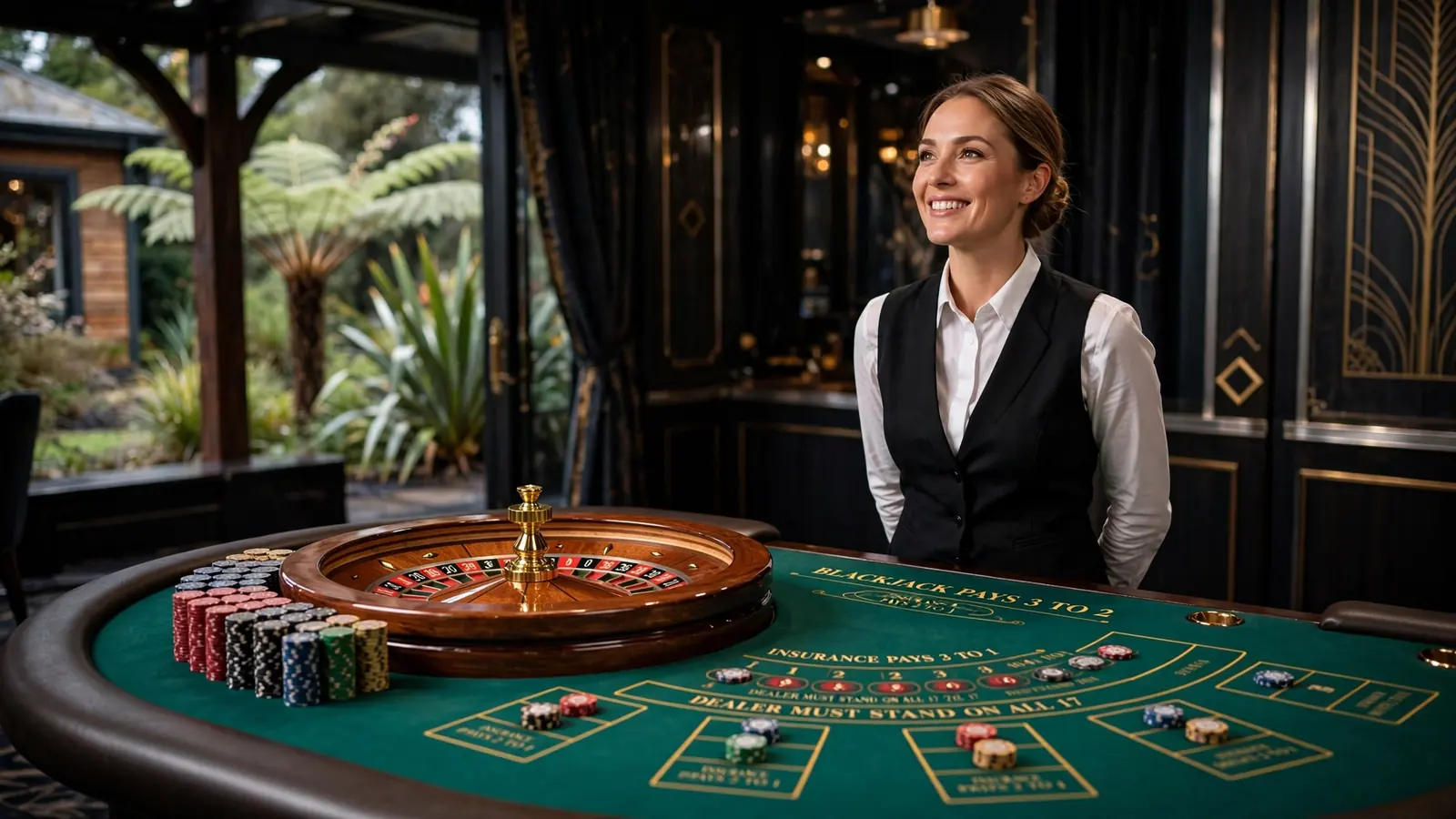
Table of Contents
- How Live Dealer Casinos Work in Practice
- What New Zealand’s Online Casino Rules Mean for Live Tables
- How to Assess a Live Dealer Casino Without Relying on a Ranking
- What to Expect from an Online Live Dealer Session
- How Live Tables Compare with Digital Casino Games
- How to Compare Live Dealer Table Features
- Live Dealer Game Mechanics and House Edges
- Bonuses and the Limits of Comparing Offers
- How to Check a Live Dealer Site Mentioned in Search
- What a “Top 10” Live Casino Comparison Can—and Cannot—Show
How Live Dealer Casinos Work in Practice
A live dealer casino combines a physical table with an online game interface. A professional dealer runs the game in a studio or a casino, while cameras send a live video feed to players over the internet. You watch the dealer and the equipment on screen, then use the interface to take part remotely.
The video is more than a visual theme. In a fully digital casino game, software generates the game’s outcomes and displays them as graphics or animation. In a live dealer game, the action takes place at a real table: the dealer handles the game, and the physical play is shown to you as it happens. The game software connects what is happening at the table with the online interface, so players can follow the same round through both.
Your screen therefore has two roles. It displays the live feed, and it provides controls for participating in the game. The dealer remains the person conducting play; you do not need to be in the studio or casino to see the table. Instead, your connection gives you a view of the real dealer and lets you interact with them through the game interface.
This arrangement changes what “live” means. The game is not simply a digital simulation dressed to look like a casino. Real people and equipment are involved, and the video lets you observe the action rather than seeing only software-rendered results. At the same time, you are still playing remotely: the camera view and the interface are the parts of the table available to you online.
So, a live dealer casino is best understood as a bridge between a physical game and remote participation. The dealer operates the table in a real location; the broadcast carries that activity to your device; and the interface lets you join the game from there. The central distinction is the source of the visible action: a real table and dealer, rather than a game presented entirely through digital animation.
What New Zealand’s Online Casino Rules Mean for Live Tables
New Zealand’s rules for online casino gambling are changing, but the transition does not create a separate licence for live dealer tables. The Online Casino Gambling Act 2026, which took effect on 1 May 2026, establishes a domestic licensing framework for online casino services. Live tables fall within the same licence category as online pokies and digital table games. A provider cannot treat its live dealer product as a separate service outside the online casino rules.
The Act permits no more than 15 licences for the online casino sector. From 1 December 2026, only approved operators will be legally permitted to accept Kiwi players under the new regime. That date marks a change in who may continue serving customers; it does not mean that every site accessible from New Zealand has already been approved or that a live table is licensed simply because it is available to play.
What happens during the transition
The Gambling Act 2003 did not allow online casinos to be based in New Zealand, and the country had no domestic online casino licensing framework before the 2026 Act. Online casino gambling supplied from offshore was not licensed or supervised by a New Zealand regulator during that period. The new legislation creates the country’s first domestic licensing system for this sector.

The transition runs from 1 May to 1 December 2026. An online casino that was already providing services to people in New Zealand before the Act began may continue operating during this period, subject to the transitional rules. This temporary permission is not the same as holding a licence under the new regime. It also does not establish that the operator will be allowed to serve Kiwi players after the transition.
Operators that have not applied for a licence must stop serving New Zealand players by 1 December 2026. A provider with an application pending may continue operating while the Department of Internal Affairs (DIA) considers it, but must not advertise during that period. If an application is declined, the provider must stop its online casino operations in New Zealand and leave the market. The full licensed regime is expected to be operational in 2027, so the transition and the final licensing system should not be treated as if they are the same stage.
Licensing Deadline
Operators that have not applied for a licence must stop serving New Zealand players by 1 December 2026.
What this means for offshore live tables
Kiwi players are not prohibited from accessing offshore gambling platforms. That does not mean an offshore operator is licensed in New Zealand, or that New Zealand’s new rules automatically apply to it in the same way as they apply to an approved domestic licensee. New Zealand does not issue a Kiwi-specific gambling licence that an offshore site can display as proof of local authorisation.
For a live dealer table, the relevant question is the status of the operator providing the casino service, not whether the table is streamed from a studio or labelled as a New Zealand product. Live dealer games are included in the same online casino licence category as other covered casino games. A separate claim about a table, game supplier or studio does not by itself show that the casino operator is authorised to accept New Zealand players.
There is also a difference between access and regulatory protection. A site may be reachable from New Zealand even when it has no New Zealand licence. Before the new framework, a customer wagering through an offshore website had no domestic government recourse. The introduction of licensing changes the legal framework, but it does not turn every accessible offshore site into an approved operator.


Checking an operator’s status
When you check a site, distinguish among three situations: an operator continuing under the transition, an operator with an application still under review, and an operator approved to hold a licence. The first two do not amount to final approval. An application in progress may allow continued service during the transition, but it does not guarantee that the application will succeed or that the provider can keep serving New Zealand players after a decision.
Confirm the operator’s licensing position with the DIA rather than relying only on a badge, a table description or a statement on the site itself. The Act allows a capped pool of licences, so the existence of the new regime does not mean every casino will receive one. Check whether the operator is approved under the domestic system and whether its status is current, especially as the transition approaches its end.
This distinction matters whether you are considering a live dealer casino based overseas or one that says it serves New Zealand. Offshore access remains possible, but access alone is not evidence of local approval. The legal position depends on the operator’s status and, during the transition, on the rules that apply to its circumstances.
How to Assess a Live Dealer Casino Without Relying on a Ranking
A ranking can help you find names, but it cannot establish whether a particular live dealer casino is appropriately regulated for your circumstances. Assess the operator itself: identify who runs the site, find the regulator it says oversees it, and verify the licence status with New Zealand’s Department of Internal Affairs (DIA). These are separate checks. A polished website, a live video feed or a high position in a comparison does not replace them.
Assess the Operator
- Identify the legal company name in the terms and privacy info
- Verify the named gambling regulator and licence reference
- Confirm the operator’s status with the Department of Internal Affairs (DIA)
- Ensure the licence relates to the specific operator and web address used
Identify the operator behind the site
Start with the site’s legal terms and privacy information. Look for the legal name of the company that provides the gambling service, rather than relying on a brand name alone. The company named in those documents should be the same entity identified in the site’s licensing information. If the site gives only a brand, or names different companies in different places without explaining their roles, you do not yet have a clear identity to verify.
Check that the information relates to the casino service itself. A company may be associated with a site in another capacity, but that does not by itself establish that it operates the gambling service or holds the relevant licence. Keep a record of the exact company name and any licence details the site presents. Those are the details you can use when checking the operator’s status.
Treat a foreign licence as a separate claim
Kiwi players can access live dealer games on international or offshore sites. That access does not mean the site holds a New Zealand licence. New Zealand does not have a Kiwi-specific gambling licence, so an overseas licence and New Zealand regulatory status are not interchangeable.

If a site says it is regulated, identify the gambling body it names and check whether the claimed authorisation applies to the company and online casino service you are considering. Do not infer coverage from a regulator’s name appearing in a footer, from a logo, or from a statement that the site is “licensed.” The useful question is whether the named operator’s licence status can be confirmed, not whether the site uses language that sounds reassuring.
Then confirm the operator’s licence status with the DIA. Match the operator’s legal name against the details the site provides. If you cannot establish that the information refers to the same company, treat the claim as unresolved rather than assuming that a similarly named business is the operator. A recognised gambling body’s oversight is an important check for an offshore site, but it should not be mistaken for a New Zealand licence.
Separate what is verifiable from what is promotional
Descriptions such as “trusted,” “safe” or “top-rated” are conclusions, not regulatory evidence. So are rankings that do not show how they established the operator’s licence status. For your assessment, give more weight to specific, checkable details: the company responsible for the service, the regulator it identifies, and confirmation of the licence status with the DIA.
If the operator’s identity or regulatory claim is unclear, pause before creating an account or depositing money. Do not fill gaps with assumptions based on the site’s appearance, a familiar name, or another website’s recommendation. The aim is not to prove that every feature of the casino is suitable; it is to establish who is providing the service and whether the licensing claim can be checked.
- Prioritize specific, checkable company and regulatory details
- Verify the operator’s identity through the DIA
- Treat foreign licences as separate from New Zealand status
- Rely on promotional labels like “trusted” or “top-rated”
- Assume a ranking proves an operator’s regulatory standing
- Fill information gaps with assumptions based on site appearance
Keep the scope of the check in mind. Licence status does not tell you whether a particular table suits your preferences, how its betting conditions work, or whether the site’s payment arrangements meet your needs. Those are separate decisions. A regulatory check answers a narrower question: can you identify the operator, and can its claimed status be verified through the relevant channels?
This approach works whether you found the casino through a comparison, an advertisement, or a direct recommendation. A ranking may organise options, but it cannot do the verification for you. Check the company behind the live dealer casino, examine the regulator and licence details it claims, and confirm the operator’s status with the DIA. If those steps do not produce a clear match, you do not have enough information to treat the licensing claim as established.
What to Expect from an Online Live Dealer Session
A live dealer session combines a video broadcast with a digital betting interface. The game takes place in a professional studio, using physical equipment such as real cards or a roulette wheel. You watch the action through a live video feed while placing your bets online. The video shows the physical game in progress; the interface is where you take part in the round.

The session moves through repeated rounds. A betting window opens, you choose whether and how to bet, and the window closes before the dealer proceeds with the game. Most live games allow only a limited time for placing bets, so you need to make your decision before that period ends. If you are still considering your options when betting closes, you may have to wait for the next round.
That timing affects how you use the session. It helps to know what you want to do before the betting window is nearly over, rather than treating the video as something you can pause while deciding. The live broadcast continues as the table operates, and the betting period is part of that operation. A late decision may not be accepted for the current round.
Once betting has closed, the dealer carries out the next stage using the table’s physical equipment. In a card game, the cards are real; at roulette, the wheel is real. The video lets you follow what happens at the table as it happens. The round then reaches its outcome, and another betting period can begin. The exact sequence depends on the game, but the key pattern is a cycle of betting, play and a new opportunity to take part.
The studio setting matters because the broadcast is tied to physical activity. You are not watching an animation of a dealer or a simulated wheel: the feed shows professional dealers working with real equipment. That makes the picture itself part of the information available to you. If you want to follow a particular action, watch the table rather than relying only on a change in the online interface.
Because live dealer games are tied to physical activity in a professional studio, the video feed itself is part of the information available to you during a session.
A session also requires attention to two things at once: the video and the betting window. The video shows the table action, while the window determines when you can enter a bet for a round. Those two parts work together, but they do not serve the same purpose. Watching the broadcast does not, by itself, place a bet; you must use the betting interface while it is open.
Technical interruptions are possible. A specialist review reports that live dealer games can encounter technical problems, although that observation does not establish how often interruptions occur across all tables. If the video or interface stops responding, avoid assuming that the round has ended or that a bet has been accepted. Check what the session displays and follow the operator’s stated procedure for an interrupted game. The outcome may depend on what was happening when the interruption occurred, so the relevant table information is more useful than guessing from a paused image.
A brief interruption can leave you uncertain about whether you saw the complete action. In that situation, distinguish what the broadcast visibly showed from what the game interface confirms. If those do not appear to match, do not treat a partial video view as proof of the result. The session’s own status information and the operator’s instructions are the appropriate points of reference.

The limited betting period is also why it is useful to settle basic decisions before a round reaches its final moments. You can watch the current action, consider whether to take part in the next round, then act when betting is available. If the window closes first, the table has moved on; you can wait for a later opportunity rather than assuming the system will accept a late selection.
In practical terms, expect a continuous broadcast with short decision periods built into the flow of play. The dealer, cards or wheel, and studio are part of the live event; the online interface connects your choices to the round. Paying attention to both helps you understand what is happening, when you can participate, and what to check if a technical interruption makes the sequence unclear.
How Live Tables Compare with Digital Casino Games
The main difference is where the game’s actions happen. In a digital casino game, software handles the game directly. At a live table, the game involves a human dealer and physical equipment, so its pace depends partly on people taking turns. Neither format is automatically better; they suit different preferences and ways of playing.
A digital blackjack game can move from one decision to the next without waiting for other players. Live blackjack can take longer because each player acts in turn and the dealer must also complete their part of the round. If you prefer a steady sequence of decisions, that difference may matter more than the table’s appearance. If you would rather play at a pace set by a real table, the pauses are part of the format.
Software handles the game directly, allowing for faster, uninterrupted turns and more readily available free-play modes.
Human dealers and physical equipment set the pace, requiring players to act in turns and generally offering no free-play mode.
The distinction also affects what you can try without wagering. Live dealer tables are generally not offered in free-play mode. Operating them requires a staffed table and other costly resources, unlike a digital game that can run through software. That makes free practice less readily available for live play. Check the table’s rules and any practice options before committing funds; do not assume that a live version has the same free mode as a digital game.
A practical comparison therefore starts with your priorities. Choose a digital game when quick, uninterrupted turns or no-cost practice is important to you. Consider a live table when you specifically want a human dealer and accept a pace shaped by the other players. A table that looks more realistic is not necessarily a closer match to your preferred experience if waiting frustrates you.
The phrase “real live dealer” can describe the format, but it does not tell you whether the game is suitable for your needs. Compare the actual play conditions: how quickly decisions follow one another, whether free practice is offered, and whether the turn-based pace feels manageable. Those points distinguish the formats without treating either one as universally superior.
How to Compare Live Dealer Table Features
A table’s name does not tell you how its rules work. When comparing live dealer tables, look at the conditions that govern each decision: when you can act, what the interface expects you to do, and how the software records what happens at the physical table. These details affect whether you can follow the game and make choices within the time allowed.

Start with the betting window. Live tables generally set a period in which bets can be placed, and some baccarat games also impose time constraints on playing a hand. Read the on-screen instructions before joining, then check whether the timer applies to betting, decisions during play, or both. Those are separate stages: a betting countdown does not necessarily describe how long you have to act once a hand is under way.
Pay attention to what happens when the clock expires. The table rules or interface should make clear which actions are available before time runs out and what the game does if you have not selected one. Do not assume that a pause, extension or automatic choice will be available. If the instruction is unclear, you cannot reliably predict how an unfinished decision will be handled.
Compare tables by how clearly they communicate these conditions, not just by how quickly a round appears to move. A short decision window can require you to read the situation and choose promptly; a longer one gives more time but does not change the rules of the game. Check the displayed information for the particular table, since conditions can differ between tables even when they offer the same game.
Check how the game records actions
In live blackjack, the physical cards and the software display need to stay aligned. A barcode scanner reads markings or chips embedded in the cards, allowing the system to register the cards dealt at the table and reflect them in the game software. This link matters because the displayed state of the hand depends on the physical cards being read correctly.
How cards are recorded
In live blackjack, barcode scanners read markings or chips embedded in the cards. This allows the system to register the physical cards dealt and reflect them accurately in the game software.
You can use this as a practical check when assessing an online casino with live dealers: look for an explanation of how the table processes cards and displays game information. The key point is not the scanner’s technical detail by itself, but whether the information shown to you follows the physical deal. If the display appears inconsistent with what you can see, do not guess at the game state. Use the table’s available support or interruption procedure rather than continuing on the basis of an uncertain screen.
Compare conditions, not labels
For each table you are considering, review its rules and instructions before placing a bet. Check when betting closes, whether a separate action timer applies, and what the interface says about an action that is not selected in time. In blackjack, also note how cards are read and shown, so you know how the digital display corresponds to the physical deal. In baccarat, look specifically for any time limit on playing a hand.
A casino with live dealers may present several versions of a game, but a shared game name does not establish that their timing or operating conditions are identical. Compare the information shown for each table individually. If a condition is not explained clearly, treat it as unresolved rather than assuming that another table’s instructions apply. This approach lets you judge whether a table’s pace and controls are understandable before you commit to a hand.

Live Dealer Game Mechanics and House Edges
Live dealer games use different rules to turn a wager into a result. Blackjack is a contest against the dealer: you aim for a hand total closer to 21 than the dealer’s, without exceeding 21. A hand that goes over 21 loses, so adding a card can improve a low total or end the round immediately. The dealer’s result matters because beating your own previous total is not enough; your hand must also beat the dealer’s under the game’s rules.
Roulette centres on the wheel result. You place a wager on an outcome, and the spin determines whether that selection wins. The house edge depends on the roulette version, so the game name alone does not tell you the full mathematical cost of a bet. For live European roulette, the stated house edge is around 2.7%; for American roulette, it is around 5.26%. The difference is significant when comparing the two formats, even though both use a wheel and resolve bets from its result.
Baccarat is a prediction game: you choose whether the player hand or banker hand will have the higher value. A round can end in a banker win, a player win or a draw. The winning hand is the one closest to 9. The house edge varies by the side selected: it is around 1.06% for banker bets and around 1.24% for player bets. These figures describe the game’s mathematical advantage over repeated play, not a prediction of what will happen in an individual round.
European Roulette House Edge Around 2.7%
American Roulette House Edge Around 5.26%
Baccarat Banker Bet Edge Around 1.06%
Baccarat Player Bet Edge Around 1.24%
When you compare live dealer casino games, keep the aim of each game separate from its edge. Blackjack asks you to manage a hand against the dealer; roulette asks you to predict a wheel outcome; baccarat asks you to choose the hand most likely to finish closest to 9. The house-edge figures are useful for comparing the stated bet types, but they do not remove chance or guarantee a particular result. A lower edge indicates a smaller theoretical casino advantage under the stated rules, not a promise that a session will be profitable.
Bonuses and the Limits of Comparing Offers
A live dealer bonus cannot be judged from its headline alone. A displayed amount or percentage does not tell you which games qualify, whether live tables count towards release conditions, or what restrictions apply to the funds. Without the complete terms for a particular offer, comparing headline figures would give you no reliable basis for deciding which one has greater value.
The distinction between bonus funds and withdrawable money matters. An offer may be subject to conditions that affect which games you can play, how winnings are treated, or when funds can be withdrawn. For a live table, check whether the offer applies to that table specifically; eligibility on one part of a casino site does not establish eligibility elsewhere. Do not assume that a promotion labelled for casino play includes live dealer games.

Promotional terms can also change. An amount shown in an old advertisement, cached page or third-party summary may no longer match the operator’s current conditions. Before relying on a promotion, look for its full terms on the operator’s own site and check that they identify the offer, eligible games, applicable restrictions and expiry conditions. If any of those details are unclear, the headline alone is not enough to calculate what you would receive or whether the offer is usable for your intended play.
In New Zealand, bonus offers are subject to a cap of NZ$100 or 200% of the deposit. Advertising of online casino services to people in New Zealand is also restricted during the transition period. These limits make it especially important not to treat a promotional claim as proof that an offer is available to you or that its headline value can be compared directly with another.
A useful comparison therefore starts with the conditions, not the advertised figure: confirm live-table eligibility, identify any play or withdrawal restrictions, and read the current terms before depositing. If the operator does not provide enough information to establish those points, set the promotion aside rather than filling the gaps with assumptions. A bonus should not determine your choice of table or encourage you to stake money you would otherwise keep.
How to Check a Live Dealer Site Mentioned in Search
A site name or web address is not evidence that an online casino is legitimate. If you encounter a domain such as indaxis.com while looking for live dealer games, treat it as a lead to verify, not as proof of the operator’s status. Search listings, reviews and the site’s own claims can help identify what to check, but they do not establish that a regulator has authorised the business.
Verify a Site
Find the legal name of the company in the site’s terms or licensing section.
Record the named gambling regulator and the licence reference provided.
Contact the Department of Internal Affairs to verify the operator’s New Zealand licence status using the specific domain and company name.
Start by identifying the legal entity that operates the site. Record the name given in its terms or licensing information, then check whether the site names a gambling regulator and provides a licence reference. Compare those details with information from the regulator itself. The relevant question is not simply whether the company has some form of registration, but whether the named gambling authority regulates its casino activity.
Check that the licence information relates to the same operator and web address you intend to use. A familiar brand name can appear on more than one domain, and a licence held by one company does not automatically establish the status of another. If the operator’s identity, regulator or licence details are unclear or inconsistent, do not treat the claim as confirmed.
For Kiwi players, the Department of Internal Affairs is the place to confirm an operator’s New Zealand licence status. New Zealand does not have a Kiwi-specific gambling licence, so do not assume that a foreign licence is a New Zealand authorisation. For an offshore site, also check whether it is regulated by a recognised gambling body; a statement on the site alone is not independent confirmation.
Keep the exact web address and operator name together when checking. If you contact a regulator or the Department of Internal Affairs, ask about that specific operator and domain rather than relying on a broad brand name. If the details cannot be verified, that uncertainty is itself a reason to pause. This process does not establish that any particular site is safe, authorised or suitable; it helps you distinguish a verifiable regulatory claim from an unsupported one.
What a “Top 10” Live Casino Comparison Can—and Cannot—Show
Choosing a live dealer casino in New Zealand is easier when you can check the concrete details available for each option. Use this list as a starting point for deciding which operators to explore further.
License: Malta Gaming Authority, licence no. MGA/B2C/370/2017 Play Grand lists a Malta Gaming Authority licence, number MGA/B2C/370/2017. You can use this detail as one point of reference when considering the operator.
Payout speed: 1-3 business days Lamabet lists a payout speed of 1–3 business days. You can factor this stated timeframe into your decision.
License: Malta Gaming Authority, licence no. MGA/B2C/394/2017 N1 Casino lists a Malta Gaming Authority licence, number MGA/B2C/394/2017. You can consider this licensing information as you explore the operator.
Payout speed: 1-3 business days Wintino lists a payout speed of 1–3 business days. You can take this stated timeframe into account when assessing the operator.
License: Curaçao Gaming Authority, licence no. OGL/2024/165/0185 BitStarz lists a Curaçao Gaming Authority licence, number OGL/2024/165/0185. You can use the licence details as a reference when considering this casino.
License: Tobique Gaming Commission, licence no. 0000064 Neospin lists a Tobique Gaming Commission licence, number 0000064. You can consider this licensing detail when exploring the operator.
License: 07017519840 · Payout speed: 1-3 business days Zotabet lists licence number 07017519840 and a payout speed of 1–3 business days. You can review both stated details when considering the operator.
License: Tobique Gaming Commission, licence no. 0000091 7Bit Casino lists a Tobique Gaming Commission licence, number 0000091. You can use this information as a reference when exploring the casino.
License: Tobique Gaming Commission, licence no. 0000002 Ricky Casino lists a Tobique Gaming Commission licence, number 0000002. You can consider this licensing detail as part of your research.
A ranked list can make several different judgements look like one measurement. A site may be placed higher because of its table selection, payment options, or editorial scoring, but the position alone does not show how those factors were assessed. Without a clear method and evidence for each claim, the order is not a reliable measure of which live dealer casino will suit you.
Treat a ranking as a starting point for checks, not as proof of quality or regulatory standing. The label “top” does not establish that an operator is authorised to serve Kiwi players, that its information is current, or that its tables match your needs. Nor does a high position guarantee a particular experience.
Check the operator’s regulatory status separately. For an offshore site, look for regulation by a recognised gambling body, then confirm the operator’s licence status with the Department of Internal Affairs. A badge or licence number displayed on a comparison page is not a substitute for checking the regulator’s own information. Make sure the licence refers to the operator and service you are considering, rather than relying on a ranking’s summary.

You can also test whether a comparison explains its criteria. Does it distinguish verified facts from editorial opinion? Does it say when details were checked? Are the same criteria applied to every entry? If the method is unclear, a precise position may create more certainty than the evidence supports.
A comparison can still help you identify questions to investigate, such as whether a site explains its licensing and table conditions clearly. It cannot decide those questions for you unless it provides current, checkable evidence. Read the underlying terms and operator information before acting on a claim, and do not infer that an omitted site is unsuitable or that a listed one is safe.
The useful outcome is not a universal winner. It is a shortlist whose relevant claims you can verify independently, with regulatory status checked outside the ranking itself.
Can New Zealand players play real-money live dealer games at offshore casino sites?
Yes, New Zealand players are not prohibited from accessing offshore gambling platforms. An offshore site is not necessarily licensed in New Zealand, so check that it is regulated by a recognised gambling body and confirm the operator’s status with the Department of Internal Affairs.
Can players deposit and withdraw using New Zealand dollars at live casinos?
Yes, many operators allow deposits and withdrawals in New Zealand dollars, though availability can vary by operator. Neteller, Skrill and Bitcoin may offer fast transactions, while payment methods can have limitations or fees.
What is a live casino dealer?
A live casino dealer is a professional who runs a game at a real table in a studio or casino. Cameras stream the game to you, and you participate through the online interface.
How do live casinos work?
A dealer runs a real game while cameras broadcast the table to your device. You watch the live feed and use the game interface to place bets and take part remotely.
What games can I play at a live casino?
You can play live dealer games such as blackjack, roulette and baccarat. These games use real equipment and are streamed from a studio or casino.
Prepared by the Casino Bonus Tips NZ editorial staff.